
The Horse Between Worlds: Notes from a South Delhi Enclave
8 September 2026
Sarbani Chakraborty
Hoofbeats
Tugbug, tugbug, tugbug…
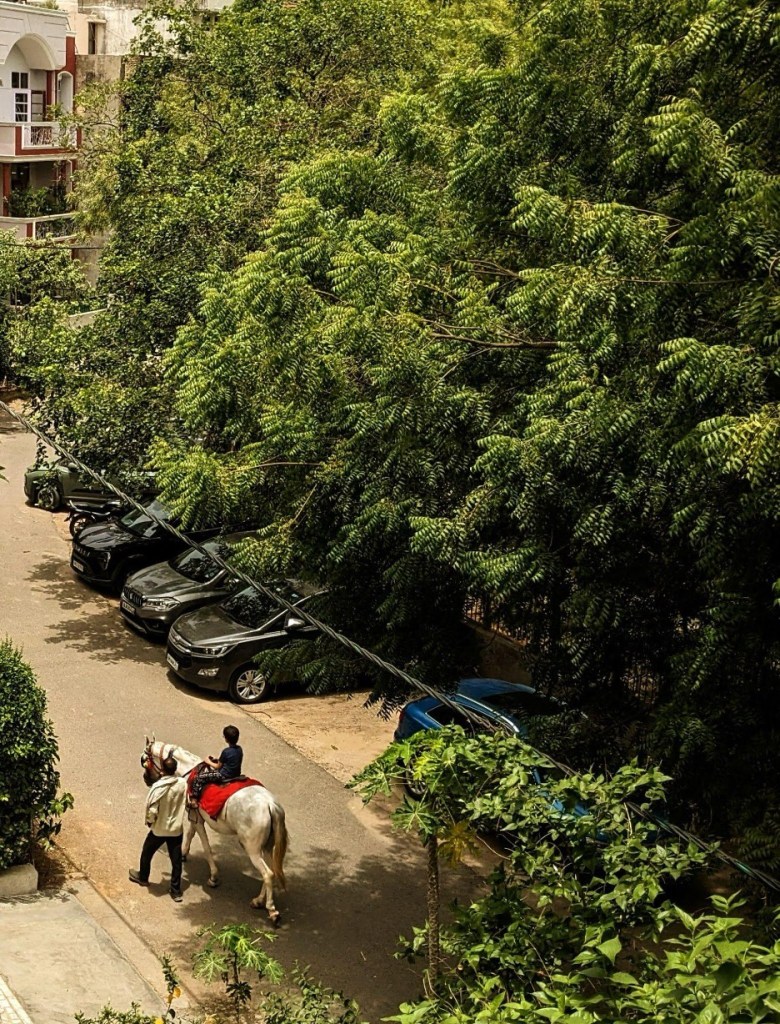
The deliberate percussion of hooves travels through a tree-lined residential colony in South Delhi. For a moment, it alters the city’s habitual soundscape. Beneath a dense canopy, a white horse proceeds at an even pace between parked SUVs, high boundary walls and broad verandahs. A child sits upright in the saddle. Beside them, the guide walks with reins gathered lightly in one hand, matching their gait to the animal’s stride. For several minutes, the visceral pulse of muscle, breath and resonant hooves displaces the metallic drone of engines.
I keep returning to this weekend afternoon ritual because the scene contains far more than it first reveals. Over years spent traversing classrooms, family homes and residential lanes – listening to children and their caregivers speak about schooling, aspiration and the futures imagined for them – I have learned to attend to the ways childhood takes shape beyond formal institutions. It settles into the routines of family life, the textures of streets and courtyards, the material worlds children inhabit and the arrangements adults construct around their days. These domains continually meet in the quotidian passages of childhood, where nurture, circumstance and expectation acquire their meaning over time.
Perhaps that is why I was drawn back, weekend after weekend, to the horse making its well-worn rounds through this South Delhi neighbourhood. What might otherwise have appeared as an incidental street tableau came to seem part of a larger ethnographic question – how the spaces adults construct around children organise their movements and, imperceptibly, reach towards futures they cannot yet know.
The horse belongs to an older geography of urban movement. Here, nevertheless, it passes effortlessly through a sanctuary hemmed in by automobiles, air-conditioned interiors and digital schedules – revealing how families seek rare moments of slowness and animate connection within an increasingly accelerated, enclosed habitat. Along this shared stretch of ‘entangled urbanism’, several ways of life meet at once – the saunter of the animal, the steady working day of the guide, the surrounding speed of the metropolis and the still-forming, leisurely experience of a young child. With each passage around the block, lingering histories cross paths with parental solicitude and aspiration. Daily labour walks the tarmac alongside leisure; contrasting senses of time ephemerally inhabit a common space.
A Different Tempo
The afternoon ride has settled into the neighbourhood’s drift. Children wait for it. Parents pause along balconies to watch the ritual unfold. From an upstairs window, the horse appears and disappears beneath the canopy, its hoofbeats announcing its arrival before the animal comes into view. The horse follows an accustomed loop each day before turning the next corner, its repetition granting the scene an unassuming intimacy.
The appeal of the ride draws upon the subcontinent’s deeper social memory. Horses have long held a complex position in the regional imagination – instruments of statecraft and ceremonial display, conduits of martial power and aristocratic self-presentation. During the colonial period, equestrian pursuits acquired associations with discipline, composure and refined self-command, entering the social archive of imperial and princely elites alike. These associations have endured beyond their original political world. Detached from empire, they continue to inform certain urban aspirations where physical poise, bodily confidence and a fluidity beyond the screen are sought alongside academic achievement.
The horse introduces an unfamiliar temporal register into the metropolitan afternoon. For many children growing up within such gated perimeters, daily life unfolds through a seamless, tightly governed regimen – climate-controlled journeys, fixed timetables, structured activities layered upon one another from morning until dusk. The horse asks for something else. Its motion emerges from the continuous negotiation of sinew, breath, weight and balance – a living system rather than a managed itinerary. For a young rider accustomed to the frictionless enclosures of modern transport, the saddle opens a sensory realm marked by physical immediacy – the radiant warmth of an animal’s flank, the lateral sway of its spine, the subtle and unpredictable intelligence of a body in stride.
The horse introduces an unfamiliar temporal register into the metropolitan afternoon. For many children growing up within such gated perimeters, daily life unfolds through a seamless, tightly governed regimen – climate-controlled journeys, fixed timetables, structured activities layered upon one another from morning until dusk. The horse asks for something else.
This elite interlude becomes more legible against the wider landscape of urban parenting and interspecies relations. Not all animal encounters in the city carry equal weight. Where working animals on metropolitan roads – pulling loads or grazing on verges – are routinely cast as urban hazards or relics of unmodernity, the gated horse is carefully insulated. It affords a refined, genteel intimacy – a sanctified, tactile communion with nature that confers status rather than defilement.
This desire for an animal connection finds a mass-reproduced counterpart in the mechanical carousels of city melas, or in the rental horses that trot along public beaches, where children climb into the stirrups less to master an equestrian art than to occupy a brief, elevated vantage point above the seaside crowd. But within the sheltered folds of the neighbourhood, the ride is stripped of its carnivalesque publicness. In this context, the horse carries the work of distinction with an unstudied grace. Its old proximity to composure and aristocratic self-fashioning has never entirely dissolved, and these unhurried afternoons renew that inheritance, whatever else they also are.
Earlier fieldwork among working-class families navigating Delhi’s precarious schooling landscape had shown me parents labouring not merely for the present but towards futures imagined well beyond it – choosing schools, stretching household budgets and reordering family life around an education that might open onto a new language, a broader social world and a more secure place within the city. Private, English-medium schooling was, in its own register, also a symbol of social elevation – a claim to having reached beyond what its circumstances might have allowed, purchased at a cost that upper-class households rarely have to weigh.
The families who arrange these afternoon rides inhabit an entirely alternative economy of possibility, one in which a child’s future rarely depends on decisive sacrifice. Here, as sunlight glints off polished leather boots and immaculate SUV bonnets, parental care operates within an abundance of resources and latitude. Experiences – horse-riding among them – can accumulate within a repertoire through which a child is cultivated, differentiated and readied for an increasingly competitive world.
Observing these children guided along the asphalt, I, as an ethnographer, discerned a familiar temporal structure. In both working-class neighbourhoods and affluent enclaves, what parents do in the present is bound to what they hope their children may become. The shape of the aspiration was manifest across both sites; but the material ground on which it stood was fundamentally separate.
For families living close to economic precarity, expanding a child’s horizon is no less cherished an ambition, yet every choice to enlarge their experiential world requires acute material calculation and sacrifice. Here, within the cul-de-sac, resources can instead be deployed without risk, seamlessly broadening what a child might experience, acquire and fold into a nurtured social self. The parental impulse to enrich a child’s life rhymes across these worlds; the structural conditions and stakes under which it is pursued do not.
That parents have arranged this experience speaks to more than one register of urban care. Within a city defined by congestion, environmental anxiety and the omnipresence of screens, the ride offers a rare interval of touch and embodied attention that the neighbourhood’s own architecture otherwise forecloses. Nonetheless, care of this kind is never free of the social value attached to the experience itself – the assurance, confidence and cultural familiarity a child accumulates on these afternoons become a form of currency that travels with them, well beyond the boundary walls. The horse arrives on schedule precisely because such spontaneous, unmediated engagements with the living world no longer arise on their own.
Circuits
The horse-keeper completes their unvarying round throughout the afternoon. Their worn sandals trace the horse’s hoofprints around the block, returning faithfully to the very point of departure. The brief interval that constitutes a child’s leisure marks the full span of their working hours.
Two lifeworlds pass along this paved lane simultaneously. For one, the passage is an interval of experiential enrichment; for the other, it is a working shift repeated from house to house. They share the single strip of tarmac while remaining governed by divergent economic gravities. This interval of leisure occupies only a few minutes of the guide’s shift; the same passage that appears as enrichment from one side of the iron gate is labour from the other. When the ride concludes, each resumes its own course without ceremony – the attendant waiting at the corner for the next household, the family retreating indoors as the afternoon settles into its customary stillness.
An old proverb comes to mind unbidden. If wishes were horses, beggars would ride. Across these recurring afternoons, the aphorism subtly reconfigures itself. Wishes indeed take the shape of a horse, though their passage remains carefully bounded within the private confines of the cul-de-sac. This path does more than trace a physical route. It maps the spatial horizon within which a particular vision of nurtured childhood is assembled and lived.
The Saddle and the Sightline
What a ride leaves behind in a child remains locked within an interiority that adult narration can only approximate.
Memory may settle on the steady warmth rising from the horse’s back, the slow shifting of muscle and bone beneath the saddle or the measured cadence of hooves striking against the lane – a sound no manufactured surface quite reproduces, reverberating faintly through the stirrups. And the child experiences this without the necessity of inventory; the encounter registers long before it can be categorised, holding meanings that they may not yet articulate. These impressions might vanish before dusk, only to re-emerge decades later, without announcement, in late-afternoon light filtering through a canopy of leaves or in the sudden, unsummoned sensation of having once been carried by a living force whose movements were never wholly one’s own.
Here lies the dual opacity of the tread. The ethnographer tracks the posture, the grip and the rhythm of the gait, but stays outside the child’s somatic register. At the same time, the child traverses an experience whose future resonance may remain entirely unmapped to them in its immediacy. What passes between the saddle and the trail is an event untranslated by either participant. The child absorbs without knowing what will endure; the observer records without knowing what has truly taken root.
Ethnography is left to trade in these suspended signals – traces that invite interpretation while withholding the reassurance of finality.
Instead of the raw interiority of the child, what comes to light is the pattern into which they are being borne. Before language grants children the vocabulary of self-analysis, they absorb the streets, walls, routines and unspoken expectations that compose their everyday life. These inheritances do not dictate how a child thinks or feels; nor do they decode the mystery of the ride. But they outline the familiar horizon within which space, touch and social life gradually become legible to the growing subject – and to the witness watching from the roadside.
The ethnographer tracks the posture, the grip and the rhythm of the gait, but stays outside the child’s somatic register. At the same time, the child traverses an experience whose future resonance may remain entirely unmapped to them in its immediacy. What passes between the saddle and the trail is an event untranslated by either participant. The child absorbs without knowing what will endure; the observer records without knowing what has truly taken root.
After the Horse
Eventually, the horse turns the corner and disappears. The sound of hooves dissolves beneath the returning hum of generators and distant traffic. The colony re-establishes its settled equilibrium.
The image persists. Its resonance lies less in the novelty of an equestrian presence on a South Delhi street than in what that presence momentarily reveals – the co-existence of multiple temporal worlds within a single urban afternoon. Horse, automobile, child and guide each navigate the lane according to separate measures and distinct rhythms of labour, leisure, biological time and machine time, while fugitively traversing a singular physical threshold. Their convergence illuminates something about the grain of contemporary elite life that is usually too diffuse to observe directly – the conscious effort to recover languor, sensory immersion and creaturely attentiveness within a milieu otherwise ordered by speed, security and technological mediation.
The horse carries more than a young rider around the block. With each swinging step, it gathers intersecting histories of mobility, labour, care and distinction, holding them briefly in relation before allowing them to disperse. The same animal that offers a child an immersion in movement, touch and another living body also belongs to a repertoire through which particular forms of childhood are cultivated and made coherent.
In this sense, the ride operates across two temporal registers at once. It is an act of nostalgic recovery – reaching back toward an imagined, pre-digital past of unhurried creaturely contact – and an aspirational project, instilling the bodily poise and status required for an elite future. For a fleeting moment, another way of dwelling within the city becomes visible – not merely as a remnant of an earlier mode of life, but as a living thread woven into the fabric of modernity itself, carrying with it the privileges, aspirations and inequalities of the world through which it moves.
The hoofbeats fade, leaving behind only the compressed dust beside the asphalt – a faint, shallow impression before the street closes back upon itself.
Dr. Sarbani Chakraborty is an education and social policy researcher and practitioner whose work spans India, Singapore, South Africa, and the United States. Drawing on public policy, social work, and human development, she studies how bureaucracies and state–society relations shape access to schooling and social protection, with particular attention to how social stratification shapes institutional delivery and lived experience. Her research examines public–private dynamics in Indian education and the governance of educational and social protection programmes, tracing how policy is interpreted and enacted within the institutional and social conditions of everyday life. She can be found on LinkedIn and X (formerly Twitter) at @SarbaniC.
creative narrative nonfiction India mobility Reflections urban ethnography children ethnography India nonhumans urban writing


