
The Fragility of Existence: Fieldwork, Vulnerability, and the Unspoken
17 August 2026
Afsheen Rizvi
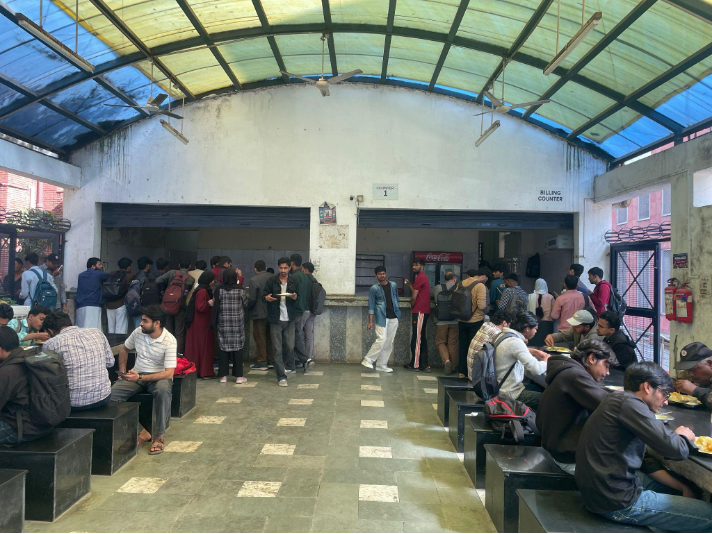
While some university students were busy eating their lunch at Jamia Women’s Canteen, we sat with Sughra trying to understand her food habits, nutritional focus and dietary preferences. The questions on our interview schedule were designed as initiators, intended to unravel individual stories based on how respondents engaged with them. With Sughra, however, these questions felt misplaced, almost absurd in their inadequacy. “Do you consume meat? Do you have eggs routinely at home?”— such inquiries seemed impossibly distant from her lived reality haunted by past traumas.
As we looked at her teary eyes and listened to her tell us about her lifelong detachments and losses, it wasn’t easy to continue. Yet, our very questions on food were responsible for her story coming out. Food brought back her memories of family and a longing for a shared meal together. Thus, food, which we planned to research in terms of its nutritional aspect, led us to its more social and cultural dimensions.
This essay is centred around the story of Sughra, one of the respondents during fieldwork I conducted in Delhi with our research team. We were aiming to understand the relation between food, nutrition and the labouring body. One site for our visit was the Jamia Women’s Canteen, one of the cafeterias located inside Jamia Millia Islamia, a public university in Delhi, India. We hoped to study this canteen run by women from marginalised communities to understand how labouring bodies ensure their own nutritional needs, and the impact of gender on their labour both within and outside domestic spaces. Sughra was one of the women working in the canteen. Her story stood out for me because it made me question the limitations of our methodological framework, even when designed with utmost consideration. We were looking for macro patterns but the individual stories layered those patterns with depth and made me question the extent of our fixed research design.
The Jamia Canteen is a women-run initiative where all staff members are women, from cooks to cleaners, front desk to management. We interviewed five women that day, each session ranging between 30-40 minutes. The selection was based on job specifications: manager, front desk in-charge, two cooking ladies, and a cleaning lady. This article develops around the last interviewee, Sughra, a petite, slightly bent over and soft spoken woman in her sixties. Her story, which unfolded in ways we did not anticipate, came to fundamentally shape my understanding of the ethical and emotional labour of fieldwork.
Our interview was not the first time I had met Sughra. She was the first worker I saw during my initial visit to seek access to the canteen. Her job let her move around the sitting area, making her more approachable than the other workers who remained invisible or were behind the front desk. I asked her for the entrance to the kitchen area where I could meet the woman in-charge. She showed me the way, and upon my return, she paused, her saree damp with water and a handful of dirty dishes in her hands, to ask if my work was complete. Then, almost in a whisper, she asked, “beta bukhar ki dawa hai kya tumhare pas?” (child, do you have medicine for fever?). I was not expecting such a question, and I had no medicine with me. I asked if she was ill and needed help. She did not reply, the brief familiarity that appeared between us disappeared. She walked away to clean the dirty dishes.
This fleeting interaction, which I nearly forgot, would later return to me. It was a moment of vulnerability, a brief, hesitant request for help from a stranger, quickly withdrawn. At the time, I interpreted it as a passing incident. In retrospect, it was a prefiguration of everything that I would learn from her story: the precariousness of her existence, her learned resignation, and the voids that structured her life.
On the day of the interview, after the canteen’s lunch rush, we sat with Sughra. The sitting area resembled more a public canteen than a university cafeteria. Instead of tables and chairs, there were two long rows of concrete slabs , with two shorter slabs for sitting on either side of the central taller slab meant for plates. Before our interview, Sughra had swept the floor, wiped the slabs and put the leftovers in dustbins. She was pale but had a shy smile on her face as she sat with us . After our basic introduction, we began with the same question schedule we had used for other canteen staff to understand food and nutrition preferences. The interview was in Hindi, with intermittent translations for our Japanese colleague.
On questions like “what did you eat last night?” or “who cooks at home?” she seemed uninterested, offering answers like “whatever is available, I eat.” Unlike our previous respondents who were either fully responsible for home cooking or actively involved in decision-making about what would be cooked (whose choice would be prioritised being a different matter), for Sughra, cooking and eating seemed questions of passive existence. Her routine bodily need for food prevailed over her desire to eat, it seemed. Food was a mere survival requirement to avoid starvation, not an active involvement in what was put into the stomach or a craving for a particular meal.
Food in India is deeply linked to family, especially domestic cooking and eating. To understand gendered decision-making and collective choices around food, we had to ask questions about our respondent’s family as well. Unlike all our previous respondents, who lived with their own families, Sughra lived with her sister’s family. She told us that both her sons had died at a young age, and her husband had left her for someone else, leaving her entirely alone. She was a migrant from Bihar. In this city, while her sister’s family was her only place of belonging and affinal affection, her hope of growing in her own family and in her own city had vanished.
Our ostensibly innocuous questions on food and nutrition unearthed her own existential insecurities about existence and belonging.
Sughra’s relationship with food was purely about necessity, as emerged from our interview, an act done for the sake of it without showing any interest in either preparing a meal, spreading a dastarkhwan (a spread popular in Muslim households) and enjoying it with her family. This shows how class and personal tragedy can sever the cultural and emotional ties to eating. She lived as a dependent with her sister’s family. She managed to earn whatever she could to justify her stay with dignity and yet was never fully involved in her own life. Hers was a state of social limbo where her identities of being a mother and a wife were lost, and her precarious existence pushed her into perpetual labouring.
Even at her age, and with constant bodily pain, which she mentioned during our questions about work-related bodily stress, she continued to work all day long. Her work was demanding, requiring constant bending, use of limbs, and carrying heavy stacks of dirty and washed utensils in the canteen. Her working hours on some days exceeded twelve hours a day, from 8 o’clock in the morning to a little later than 8 at night. In contrast to our other respondents with relatively secure familes, who voiced a reluctance to work or a need for rest , Sughra had no such emotional refuge.
In our further questions to understand her awareness about government policies related to food and nutrition, such as the Public Distribution System (PDS), we discovered that she had lost her Aadhaar Card. The Aadhaar is a unique identification card issued by the Government of India, serving as proof of identity as an Indian citizen and facilitating financial inclusion and access to welfare schemes. PDS, for example, grants marginalised populations monthly rations. She did not even remember when she lost her Aadhaar card. This loss amplified her despair, trapped as she was between social uncertainty and legal invisibility.
The Jamia Canteen is within the premises of Jamia University, which was one of the important centres of massive demonstrations across the country after the passage of the Citizenship Amendment Act in 2019. Shaheen Bagh, a Muslim majority area in Delhi, located near by Jamia Nagar, became globally recognised for the protests, many led by women like Sughra . Losing her Aadhaar card as a Muslim woman in contemporary India extended far beyond mere bureaucratic inconvenience. It was a deeply existential threat. Her lack of documentation symbolised a latent threat to her basic rights and her claim to being a legitimate citizen of the country.
The roles that once anchored her identity had been lost. Without an Aadhaar card, her claim to citizenship and the entitlements that came with it hung perilously in the balance. Our ostensibly innocuous questions on food and nutrition unearthed her own existential insecurities about existence and belonging.
We found ourselves at an impasse, unsure how to continue without appearing callous or indifferent to the grief that now filled the space between us. The flow of the interview broke down not because the respondent refused to speak, but because what she said raised further questions which were outside our research questions. Her tears and fixed gaze spoke louder than words as the canteen gradually emptied after lunch hours. Fieldwork often stirs trauma that cannot be captured by an hour-long semi-structured interview schedule and ranges far from the scope of the study.
As we approached the end of our interview, she said, “if my sons were alive today, they probably would have been your age”. A dream she had once carried, now surviving only as imagination in their absence, served as a quiet reminder of the ethical weight such encounters carry. The fragility of her existence, her silence on our questions about food and nutrition, and her hopelessness reveal how nutritional health is inextricably linked to emotional and psychological wellbeing, which are in turn destroyed by social abandonment. Sughra, though aware of the purpose of her everyday existence i.e. working in the canteen from 8 am to 8 pm, was unsure of her social identity.
Ruth Behar writes that “anthropology has always been vexed about the question of vulnerability” (1996, 5). The question of vulnerability applies to both the observer and the observed. We sat together as strangers, but in the course of fieldwork, we discovered things about our respondents which were difficult to anticipate. Our interview schedule, a single homogenous set of questions divided into various sub-sections designed for a similar set of samples, was intended to create comparability. Yet the same schedule led to the weaving of intricate details unique to each respondent.
For us, it was a day of fieldwork. For our respondents, it was an occasion to reflect on their own mundane activities and lives. How can one separate their thoughts into clear answers severed them from their clouded headspace, the memories of loss and feelings of despair that they carry with them? This is the methodological question that remains unresolved: How do we design research that recognises our respondents in their entirety, without reducing their lives to data points? How do we listen to silences as much as we record speech? How do we remain present to the grief that our questions might invoke, without retreating into a false objectivity?
One’s relationship with food is mediated by multiple primordial factors: family, memory, belonging, and identity. For Sughra, these factors had been systematically eroded. Her responses offered testimony rather than evasion. “Whatever is available” revealed a life stripped of choice, not a refusal to answer. Even her silence carried meaning, a form of data, a reminder that some experiences resist articulation within the boundaries of our research instruments.
For us, it was a day of fieldwork. For our respondents, it was an occasion to reflect on their own mundane activities and lives. How can one separate their thoughts into clear answers severed them from their clouded headspace, the memories of loss and feelings of despair that they carry with them? This is the methodological question that remains unresolved: How do we design research that recognises our respondents in their entirety, without reducing their lives to data points? How do we listen to silences as much as we record speech? How do we remain present to the grief that our questions might invoke, without retreating into a false objectivity?
The challenge, then, is not to eliminate vulnerability from fieldwork but to recognise it as constitutive of the research process. My own fear of observing too coldly or getting carried away in that moment was an ethical response to the encounter. It is this vulnerability, this recognition of our shared humanity, that allows us to move past the extraction of information, toward something closer to understanding.
Sughra’s story, which began with a question about fever and ended with tears, from her damp saree to her damp eyes as reflective of the dampness of her life, remains with me as a reminder of the ethical weight of our work. It is a weight we cannot, and should not, set aside in the name of objectivity. Instead, we must carry it with us, allowing it to shape not only what we see but how we see it.
This methodological reflection is based on fieldwork conducted under the ICSSR-JSPS project on “Labouring Body, Food and Nutrition.” The name has been changed to protect the identity of the respondent.
I would like to extend my gratitude towards ICSSR for funding our research and Prof. V. Sujatha, CSSS, JNU, India for giving me the opportunity to be part of this project. I would also like to extend my gratitude towards Prof. Y. Sato, Tsuru University, Japan and my fellow research assistant Shreyasi Singh without whom this fieldwork in Jamia Canteen would not have been possible.
P.S: After February when this fieldwork was done, I followed Sughra. The Jamia women’s canteen closed temporarily following the LPG cylinder price hike in India. I could not find the whereabouts of Sughra, but one day I found her working in another canteen within the university and we had a brief chat about how her current job is more tedious and demanding and she wants to return back to Jamia women’s canteen. The women’s canteen is open again now, but she wasn’t taken back.
References
Behar, R. (1996). The vulnerable observer: Anthropology that breaks your heart. Beacon Press.
Afsheen Rizvi is currently a PhD candidate at Department of Sociology, Jamia Millia Islamia, New Delhi, India. Her research focuses on hereditary musicians in North India, exploring how hereditary artistic communities navigate the paradox of cultural indispensability and social stigmatization in contemporary India. She is also working as research assistant for ICSSR-JSPS project on “Labouring Body, Food and Nutrition”. She can be found on LinkedIn.
fieldwork reflections research process anthropology epistemic violence ethnography reflexivity writing


