
The Cats that Belonged to Nobody
29 November 2026
Anasua Chaterjee
It was a late September afternoon when Tipu lay sunning himself on the ledge of the khirkee-r dorja (secondary entrance) of the Mukherjees’ house, only a short way from the busy Gariahat crossing. Lunch had been to his liking, a particularly oily fish mixed with rice left outside by the water tap by Nondo, the cook. The soft September sun was a relief after the long spell of rain in the city. Tipu sat indolently, looking up and down the sleepy little lane. It would still be a few more hours before Moti – the White Owl – came to sit on the Gulmohar branch opposite, and they could talk. Tipu liked Moti; she was equally prim and proper, and shared his disdain for Golu, Bholu, and Sheru, the neighbour dogs who simply created chaos in the street. Suddenly he spotted Shundori strutting down the lane, wending her way through the cars parked along the pavement.
“Such a show-off,” muttered Tipu, turning away to look insouciantly at the trees.
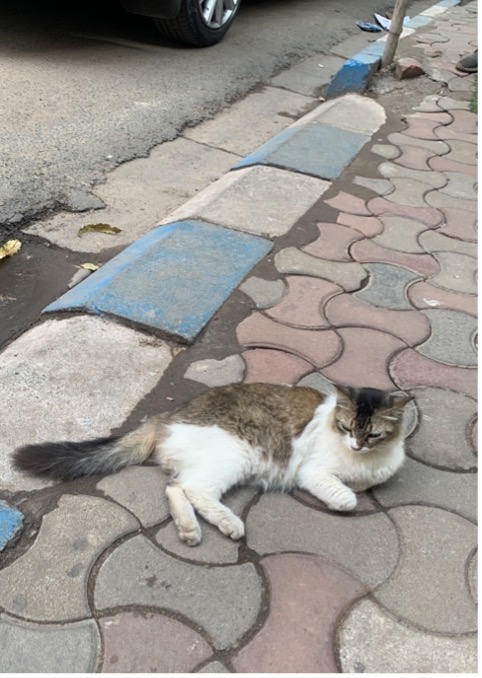
Shundori, a beautiful grey-and-white tabby with a thick tail lived at Hangout, a local café just up the lane, where youngsters thronged through the day, producing a steady stream of fancy treats for the resident cat. Besides, cats were nowadays cool on the internet, and humans wanted a share of that. Shundori, being rather self-absorbed, was well-aware of her status. She often posed for the camera, but not without Temptation pockets and a thorough head scratch beforehand. No regular maach-bhaat (cooked fish and rice, a typical Bengali meal) for her.
“What’s up, Tipu da?” Shundori asked as she stopped briefly and looked up at Tipu’s perch. She was too self-conscious to lounge on a mossy ledge in broad daylight, but it always brought back distant, warm memories. She and her two siblings would lie with their mother on a short mossy wall that ran between two houses shaded by a Shiuli tree…. but that was a long time ago.
“Have you heard that Mini has been ‘adopted’? The fishmonger Mohon took her home for his daughter. I would say she has been ‘kidnapped’. Poor Mini,” said Shundori as she flicked her tail and looked at a passing car.
“What poor Mini?” Tipu retorted. “After the Ghoshes gave up their house for promoter-i (small-scale real estate development), Mini and Lily had a bad time. Mini was never quite as smart as Lily. She would wait for hours just for him, hoping for some fish.” Tipu sort of liked Mini. She was quiet and gentle, unlike the sly Lily or the intimidating Shundori. Most importantly, she respected him.
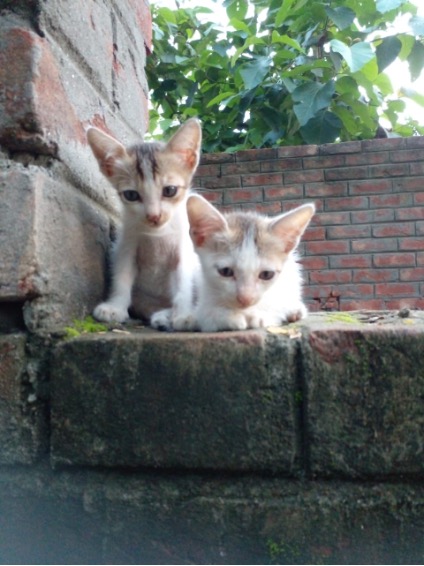
Shundori only had eyes for Saheb, a young white cat with gray blue eyes who was quickly rising through the ranks of the neighbourhood’s feline fraternity. At two years old, he was in good shape and resourceful, too. He made his daily rounds, covering three houses in the vicinity, and settled smugly, as evening progressed, between the tea stall and the press-wallah for his fair share of titbits and attention.
Tipu had not failed to notice how Saheb was almost discovered while making off with an entire piece of freshly washed fish from the Duttas’ kitchen the other day. “Such an unnecessary risk” Tipu had thought. “That’s what gives all cats a bad name.”
He knew he was particularly lucky. The deeply religious Nondo associated him with Ma Shashti – the Bengali Hindu goddess of fertility and protector of cats – and always gave him a little fleshy bit from her own portion of fish. But still.
Such are the everyday lives of Tipu and the other feline denizens of a Kolkata para – a residential neighbourhood – where cats move freely between houses, walls, lanes and alleyways, belonging to no one in particular, yet somehow to everyone – to the place and its people.
I stumbled into Tipu’s world quite by chance, in the course of my fieldwork on the paras of Kolkata. Hindustan Row, where Tipu lives, is still one of those few neighbourhoods where a para-like ambience still persists. Part of the city’s twentieth-century southward sprawl beyond the colonial White Town, it bears traces of a genteel, Bengali middle-class life, built around one- and two-storeyed detached houses enclosed by boundary walls, along a mesh of quiet leafy lanes and narrow, winding alleyways.
Despite their modernity – visible in semi-circular Art Deco verandahs, clean lines and elaborate wrought-iron grills – these houses retain elements of the older spatial arrangements typical to the more traditional paras of North Kolkata, including divisions shaped by caste and utility. The ledge on which Tipu sunned himself, for instance, represents the distinction between the main entrance called the sadar-dorja and the kirkee’r dorja, a secondary entrance traditionally used by servants and other service providers. Other architectural features include the wide sills of the louvred windows adjacent to the street reminiscent of the rowack – a raised ledge or platform along a house frontage; the kol-tola, a cemented area around a water tap; and open first-floor balconies that sit within easy view of the lanes and by lanes.
The porosity of its built form lends the para a curious intimacy. Neighbours know one another, as well as the regular rhythms and goings on in the para. They lean on one another for support and reassurance, even as their working lives take them outside, elsewhere in the city. Together, they sustain a shared social life that extends beyond the home, offering forms of familiarity and mutual support that can be difficult to find in the anonymity of the wider city. Most paras have their own ‘clubs’ – informal associations usually of local men, operating from a modest room and organizing the collective and cultural life of the neighbourhood, from the annual Durga Puja to musical evenings and occasional winter picnics. The local grocer, tea-stall owner and press-wallah (local ironing service provider), too, belong to the para without necessarily residing in it.
This is not to suggest that the para is an entirely egalitarian or utopian world. Rather, its apparent social heterogeneity coexists with deep hierarchies that shape who belongs, who is welcome, and who remains at the margins. Thus, while Mohon and Nondo are regulars in the para, and participate in a network of care, they can never claim the same sense of ownership in the way the Mukherjees and the Duttas, who own family homes there, can. If one day, like the Ghoshes, they choose to give up their houses for redevelopment, there is little anyone can do to prevent that. Mini’s predicament and her eventual uprooting when Mohon took her home is testimony to just that – the ultimately asymmetrical nature of belonging the para affords.
Yet its relatively open thresholds and shared spaces make possible forms of everyday encounter among residents, regulars, visitors and animals that are difficult to sustain in the vertical, enclosed gated communities that are increasingly appearing across the city.
It is within this intricate entanglement of human and non-human lives and urban space that the para cat presents itself.
Tipu, Shundori and Saheb are free-roaming cats. They belong to the para much as Golu, Bholu and Sheru, the lanky, white-and-brown canine trio who fiercely guard the lane, do. They are not pets in the sense Mishku, my orange tabby, is. He is a strictly indoor cat who lives with me in my apartment, eats carefully selected cat treats and sleeps in total abandon, paws up in the air and belly exposed. He does not so much as think of venturing outside beyond the occasional, much despised car ride to the dreaded vet. I suspect he wouldn’t survive five minutes on the streets.
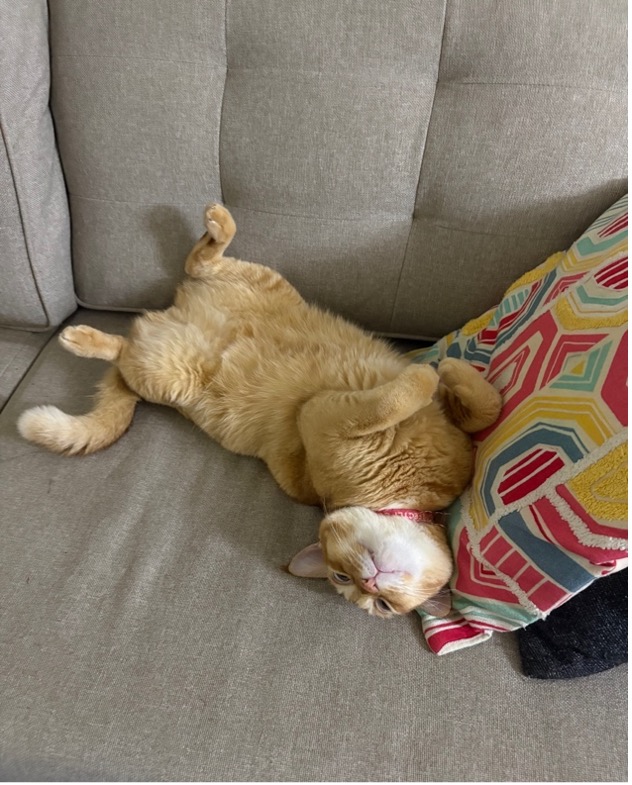
While I am grateful for the quiet presence and the periodic chaos Mishku brings to our otherwise quiet home, Tipu’s world reveals to me an entirely different mode of co-habitation and belonging.
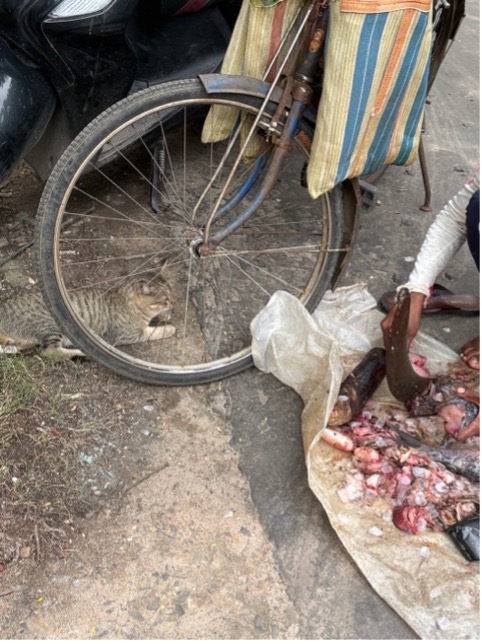
Unlike urban house pets, whose worlds are organised around domestic interiors, Tipu and the others roam freely around Hindustan Row. Yet, they are not strays in the sense of being unwanted or treated as a nuisance. They have their own preferred spots – a chair in someone’s verandah, a wide windowsill, a particularly well-placed ledge from which to keep an eye on the perimeter; they have their routines – mornings near the fishmonger Mohon who rides around the neighbourhood on his bicycle with a basket of fresh fish and a rather sharp bonti for slicing them; afternoons near the more generous kitchens; evenings around the tea stall or the chop-er dokan that offer a variety of fried fritters, including juicy fish and chicken cutlets. They have their own routes which routinely confound human reckonings of space and distance, and, of course their favourite humans. They also know which people are skeptical of their presence and keep out of their way.
The cats are familiar with the rhythms of human life and of the city, too. They are alert to the ebb and flow of traffic along the lanes, seemingly knowing when to cross a street and when to avoid the main road. Humans, by comparison, are sloth-like – misshapen giant cats who can’t possibly know how to hunt. Yet, somehow, they always have food. Besides, they can also be an extraordinary noisy lot.
Come autumn, temporary bamboo structures spring up all around the neighbourhood, draped in bright colors, while lights transform the quiet evenings. The loud rhythmic beat of the dhaak, amplified through loudspeakers begins at dawn, as a steady stream of visitors arrives to participate in the festivities. Itinerant children burst firecrackers in the street. This annual carnival unsettles the otherwise familiar routines of the neighbourhood’s cats and sends the fearsome canine trio crawling under the parked cars lining the lane. Tipu temporarily shifts to the Duttas’ open terrace, just a short jump from the boundary wall that lay beyond his ledge. Saheb and Lily simply vanish, while Shundori retreats to her very own cozy nook set up by the café manager who loved cats. Moti, too, can barely sleep through the din.
The cats are familiar with the rhythms of human life and of the city, too. They are alert to the ebb and flow of traffic along the lanes, seemingly knowing when to cross a street and when to avoid the main road. Humans, by comparison, are sloth-like – misshapen giant cats who can’t possibly know how to hunt.
They all long for the para to return to its familiar rhythms, so that they can go back to living their ordinary lives.
Yet for all their familiarity with the neighbourhood, Tipu and the others are not what is commonly referred to as ‘community cats’. In Japan the chiiki-neko programmes, which include trap-neuter-return initiatives and shared community responsibility, typically bring together residents, volunteers and local municipal authorities to organize identification, sterilization, feeding and other forms of care. Better known internationally is France’s chat libre initiative, which provides for the sterilization and vaccination of certain free-roaming cats which are then returned to their territories, their care supported by designated associations and local residents.
Within such arrangements, the free-roaming cat is not simply a stray. Its place in the community is made legible through formal administrative recognition, as in the French framework, or through established practices of collective care, as in the Japanese programmes.
The para cat follows an entirely different logic of urban inhabitation. It is not part of any organised programme, nor is its life overseen by any single person or institution. Neither is it an administratively legible member of its species. Its continued presence, access to food and everyday care are sustained instead through a diffuse, network of relationships, rooted in a strong place-based sense of belonging, namely that of the para. Here, belonging rests on familiarity, proximity and knowledge accumulated through generations of living alongside one another. The cats are known, their habits recognized, and their absence often noticed. Within this configuration, humans and cats become members of the para through an ongoing entanglement of lives, spaces and everyday encounters, without anyone necessarily having to formally declare them para’r beral – cats of the para.
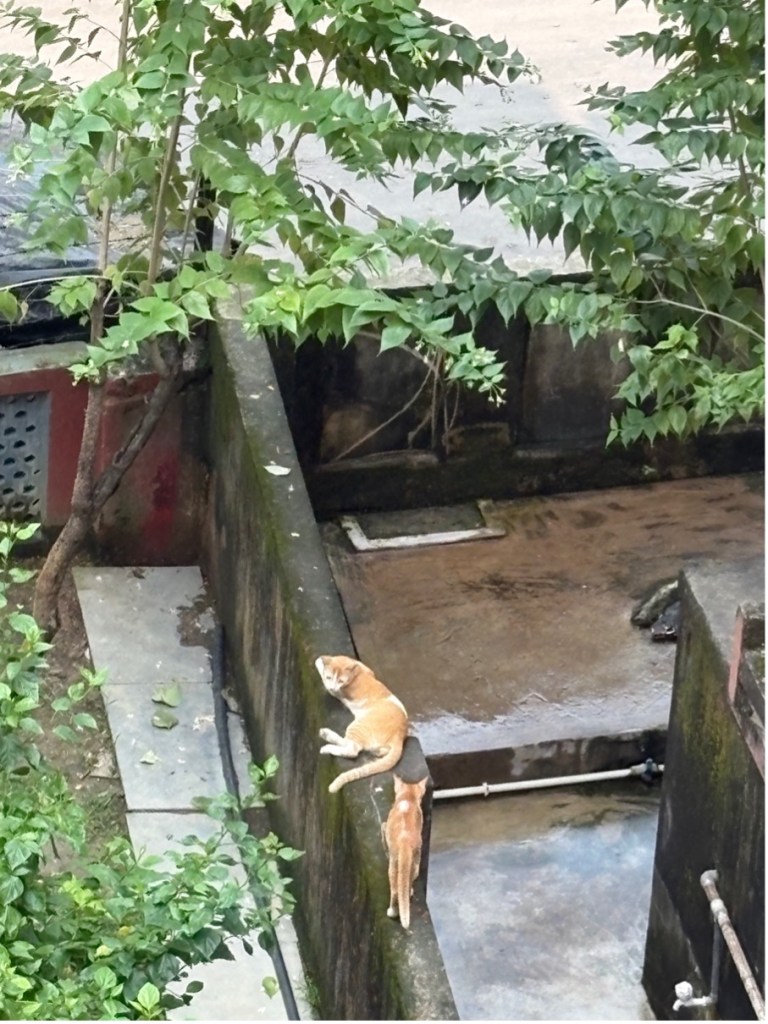
The Mukherjees, for instance, remembered Tipu’s mother, Lokkhi, who true to her name was the gentlest of cats; the press-wallah recalled how Shaheb had been found one winter morning – a tiny white kitten, with two others who unfortunately did not survive beside the dying embers near his stall, and the Duttas, along with most of the residents on the row, knew that food had to be secured whenever Lily was on the prowl.
And what do the cats bring to the neighbourhood? Certainly, they bring their own share of unpredictability and chaos. Mr. Mukherjee, one of my interlocutors, recounted how, just the other day, Tipu had toppled a pot of milk cooling on a stool in the drawing room during one of his frenzied retreats, possibly after aggravating Sheru. Nondo, meanwhile, complained that Lily had hidden two kittens under the staircase the previous winter, which she was then tasked to care for until they were old enough to venture into the outside world. Yet, their presence is by no means unwelcome.
For one, the cats add to the familiarity of the neighbourhood. Just as the houses, the tea stall and the press-wallah are fixtures of the para, there is a certain reassurance in seeing Saheb lounging around the tea stall for titbits in the evening, or Tipu basking on a sunny ledge as one walks down the lane. In a way, the sight of a cat strolling nonchalantly through the narrowest of lanes signals a sense of domesticity and warmth; a world where domestic life spills beyond the walls of the home, where an animal can find food, and feels sufficiently safe to loiter.
For the residents of the para, perhaps, the sight of Tipu and the others evokes a familiarity of place; one imbued with the warmth of fictive kinship and the predictability of the everyday micro-routines. Within an otherwise fast-changing and uncertain urban landscape, such ordinary rhythms offer reassurance, providing subtle anchors to everyday urban life.
Further, even though the cats belong to nobody in particular, they offer a sense of ambient companionship to whoever cares to stop by with a chin scratch and, perhaps, a few treats. During my many walks around the neighbourhood, I often spotted Piku, the Duttas’ daughter, stopping by the tea stall to play with the cats, her little brother in tow. One day, while I had stopped for tea, Piku informed me stoically that her parents wouldn’t let them have a pet cat. “Or even a dog. Mum said no to pets,” Piku explained matter-of-factly, even though she is occasionally allowed to carry bright pink Whiskas pouches to feed the cats.
I was no stranger to Piku’s mother’s concerns. For most working parents – including my own, when I was a school goer – a house pet represents an additional responsibility, requiring time, care and attention. But a neighbourhood cat, whose habits and ways are fairly well known, can still be a welcome companion for children. As Piku’s mother once explained, ‘I don’t want them to be scared of them or drive them away. Children need to learn to be kind to animals and know that they will not necessarily harm you.’ Piku and her brother could have precisely this kind of everyday contact with animals without having to own a pet.
Besides, familiar adults are usually around to keep an eye on things and intervene if an encounter became uncomfortable or an animal turned aggressive.
Over the past decade and a half, Kolkata has witnessed an accelerating transformation of its residential landscape, marked by verticalization, increasing exclusivity – as seen in the proliferation of gated apartment complexes and residential communities – and the institutionalization of relationships and services, all of which, have, together contributed to a steady shrinkage of para spaces across the city.
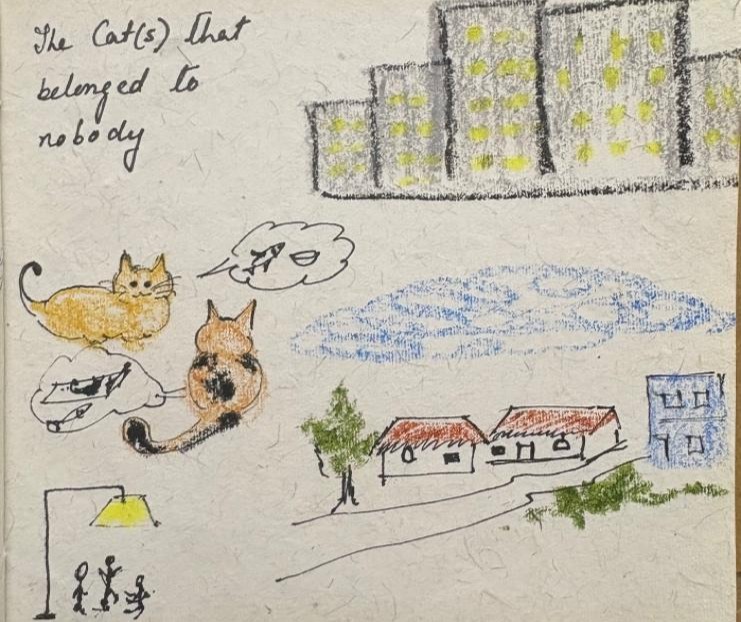
Gated vertical developments, with their standardized designs and rationalized architecture, leave little room for the fluid threshold spaces that the cats can appropriate. There’s no sunny ledge, open nook or first-floor terrace for a cat to claim as its own. Where conducive spaces do exist, they are largely monitored, and a cat casually lingering around stands a strong chance of being classified as a ‘stray’ and removed from the premises. Nor do cats get to enjoy the warmth of liminal domesticity within a milieu where exclusive house pets tend to be preferred. In my many visits to Horizon, an upper-middle-class gated community in the southern part of the city, I have almost never seen a cat strolling along the pathways, across the lawns or through the stairwells.
Gated vertical developments, with their standardized designs and rationalized architecture, leave little room for the fluid threshold spaces that the cats can appropriate. There’s no sunny ledge, open nook or first-floor terrace for a cat to claim as its own.
Stricter rules around waste disposal, increased dependence on app-based delivery services and more tightly controlled entry and exit points leave little room for socialization outside of designated spaces. The small groups of para dwellers gathering around the press-wallah’s stand or the tea stall, and the fishmonger on his bicycle stopping at doorways to cut, clean and deliver the day’s fish barely find a place in the civic life of such housing. Alongside the transformation of established architectural forms, what may also be disappearing is an altogether different mode of belonging to the city, one made possible by the thresholds, shared spaces and informal networks of community and care that the para exemplifies.
Cats are resilient creatures, having found their way into human hearths over millennia. They have, and will continue to find ways to survive. Increasingly, they congregate in the city’s commercial spaces – the wet markets, the rubbish dumps and even the small tea-and-cigarette stores that offer rare spaces of working-class sociability beyond the large gated complexes. A growing civic consciousness around street animals, alongside efforts of local youth groups, has also given rise to sporadic community-based initiatives to spay, vaccinate and feed free-roaming cats and dogs. But can survival ever be the same as belonging?
The kinder and more hospitable spaces of multi-species inhabitation, and the networks of coexistence and care outside of ownership and institutionalization that para spaces once afforded, are becoming harder to sustain.
And with them may also fade the delightful stories of Tipu and Lily, Saheb and Shundori who animate the para though mystery and mischief, myth and meaning, and the predictable rhythms of the everyday.
Anasua Chatterjee is a social anthropologist based in Kolkata, working on urban life, communities and identities, and the evolving landscapes of Indian cities. Her doctoral research explored the making of Muslim-majority neighbourhoods in Kolkata, published as Margins of Citizenship: Muslim Experiences in Urban India (Routledge, 2017). Her current interests include urban place-making, neighbourhood and housing transitions, and embodied approaches to urban ethnography. She can be reached at anasua.chatterjee@rksmvv.ac.in.
photo essay urban ethnography India nonhumans ethnography anthropology India nonhumans urban interspecies urbanism


