Listening for the Dead in the Rubber Hills of Sumatra
November 1 2026
Rahardhika Utama
Mornings in the Rubber Hills
Life in the household where I lived for most of my fieldwork began in the dark, when Pak Suko rose before the first call to prayer and I lay under a thin blanket listening to the water in his ablution jar and the low murmur of his Subuh prayer coming through the bamboo wall. Before dawn the village was cold and still, and the damp earth held the smell of last night’s woodsmoke. Somewhere down the slope a rooster started crowing long before there was any light. By five we were on the trail, Pak Suko ahead of me with a knife at his belt and a bundle of tapping tools over his shoulder, and I behind him with a headlamp that I soon learned to switch off. Its beam showed me only a small circle of ground and made everything outside it look blacker, so I kept tripping over roots that my host stepped over without looking. He knew the path by heart, and he seemed to feel his way by the faint gray of the sky above the trees. The walk took an hour, down through the thick green of the old plantation and up again onto the far hillside where his rubber plot lay. Over those weeks the trail became a kind of classroom, and the lessons came in pieces, between a comment about the history of the land and a warning about a slippery root.
Pak Suko had tapped rubber since he was a young man, and he grew up on the edge of what was once a Dutch plantation. You could still see its layout in the long, straight rows of rubber trees standing above the younger forest, a grid the Dutch had planted and the forest had never quite taken back. His wife, Bu Wo, treated me less like a researcher than like a late arriving child. I was a researcher, though, a graduate student writing a dissertation on the history of the rubber economy across Southeast Asia, and I had come to these hills in eastern Sumatra, Indonesia, because they once sat at the center of the world’s rubber trade. This was only one of several places where I did fieldwork, but it was the one where the history felt closest to the ground. She fed me like a child too, and every morning she wrapped our breakfast in banana leaves, stir-fried tofu and tempeh with a spoonful of rice and a boiled egg. The leaves were warm and slightly waxy in my hands, and they smelled faintly sweet, mixed with garlic and chili. She always packed more than the two of us could eat, because she knew that tappers in neighboring plots sometimes came to work with nothing at all. Sharing food was so ordinary to her that she never mentioned it.
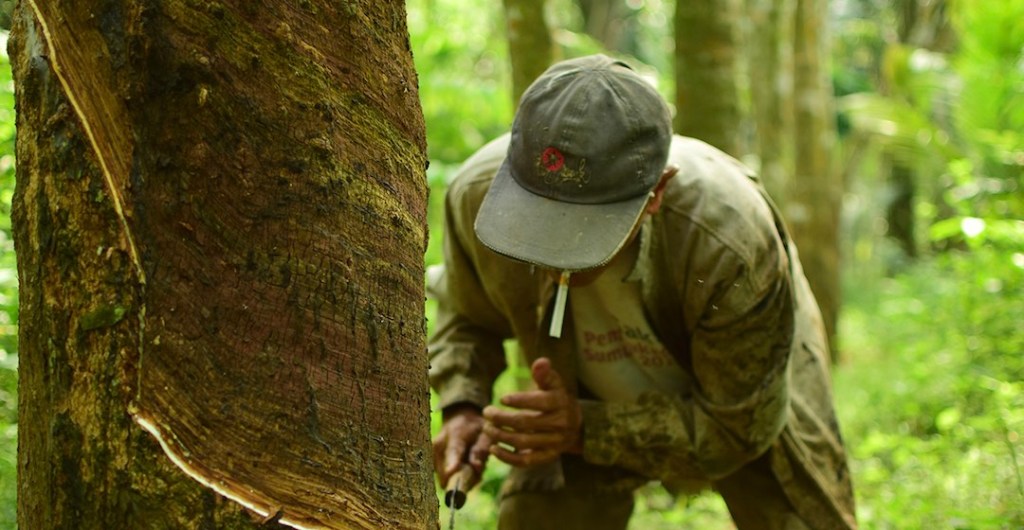
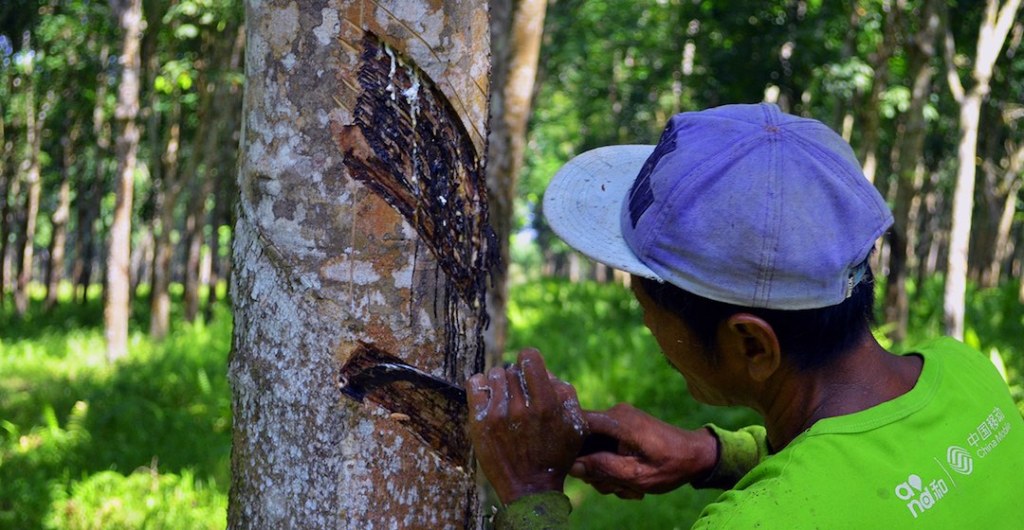
At the plot I learned to watch before I tried to help. Every tree carried the marks of earlier tapping, a band of ridged, darkened bark where the same cut had been renewed day after day for years. Pak Suko would run his thumb along it to find the last cut, then shave a thin new strip just below it with one shallow stroke of the blade. Within a few seconds the latex began to bead along the cut and drip down the channel into the bowl, each drop landing with a soft tap against the bottom. The fresh cut smelled sharp and a little sour, like milk just beginning to turn, with a damp, sappy edge like snapped stems. In the late morning the bowls would be full and heavy, and the latex left on my fingers dried into a tacky film that I peeled away in long translucent strips. I carried water up from the river that ran along the lower edge of the plot, the cold of it numbing my forearms, and when the work paused we sat on an upturned crate and talked with whichever old grower happened to be nearby, men whose hands were cracked and stained and whose conversation proceeded at the unhurried pace of people who had long ago stopped expecting that anyone from outside would care how their trees were doing.
I mention these mornings at length because the story I want to tell cannot be understood apart from them. Ethnography is often described as the practice of getting close to people, but in my experience it also means being taught by them how to perceive. Pak Suko and the other growers taught me how to hear the quiet of a plot at dawn and how to read a tree the way a tapper does. They also taught me, without ever saying so, that some parts of the past were not discussed head-on. People came at them sideways, by pointing out a scarred trunk in passing, by lowering their voices, or by letting a sentence trail off. By the Friday I describe here, I had spent enough weeks in that routine to sense that the hills held things people would not say aloud.
The Friday I Overslept
I had stayed up far too late the night before, hunched over my notebook under a single bulb while moths knocked against the glass, trying to get down everything I had heard that week before I started to forget the details. When I woke the light in the room was already the wrong color, a thin and slightly yellow wash that told me before I looked at the clock that the household had moved on without me. Pak Suko had gone ahead to the plot and left word with Bu Wo that I could either follow on my own or stay and help prepare the food that the neighbors take turns cooking for the men who attend Friday prayers at the mosque, a rotation of small kindnesses that holds the village together more firmly than any formal institution.
I chose the trail, partly out of embarrassment and partly because I did not want to lose a morning of observation, and I ate a hurried breakfast of banana fritters, still glossy with oil and tasting of caramelized sugar, along with a glass of tea so bitter that it seemed to scrape the inside of my cheeks. Then I set out alone at about nine o’clock, an hour when the cool of the early walk has already burned off and the humidity begins to settle on the skin like a damp cloth, and when the forest sounds are thinner and more distant because the birds that sing at dawn have retreated into the shade.
It is difficult to explain how different the same trail feels when one walks it without a guide. Every bend that Pak Suko had made unremarkable by his easy passage now asked something of me, and I found myself noticing the sheen of the leaf litter, the way the red clay clung to my sandals, the insistent whine of cicadas rising and falling like a tide in the canopy. Somewhere along the upper slope I passed through the faint sweet rot of fallen fruits and then through a pocket of cooler air that smelled of stone and moss, and I remember feeling a mild, unfocused happiness at being alone in the hills, a feeling that I would later think about with considerable unease.
A Man at the River
As I came down from the crest I saw, on a stretch of ground close to the river, an old man hauling water in a dented bucket with flecks of paint still on its sides. Nearly every grower I knew used one, since empty paint buckets were cheap and sturdy and easy to find. I could hear the splash of it from where I stood, a hollow metallic slap that carried up the hillside, and I watched him make the same short journey again and again between the riverbank and a scatter of aged rubber trees, his bare feet pressing the mud into little pools that filled behind him. Custom among rubber growers holds that one does not pass a neighbor at work without a few words of greeting, and since I was a guest in the area and conscious of my own awkwardness I intended nothing more than a lifted hand and a polite exchange before moving on toward Pak Suko’s plot.
The man set the bucket down and straightened, and he turned toward the path with the attentive stillness of someone who has been waiting for a visitor, so that my passing became, in a way I could not have explained, impossible. I approached and offered the greeting, and he answered it, and in the space of that exchange I took in the details that have never left me. His name was Pak Sudharmo, he said, and he was in his seventies, born during the Japanese occupation. His eyes were heavy lidded and patient, very much like those of my own grandfather, the eyes of a person who has seen so many terrible things that nothing in the present can surprise him, and beside his mouth he had a small mole that slid sideways when he smiled, exactly as my grandmother’s used to do. I felt, absurdly, as though I had been recognized, and I think this is why I did not hesitate when he invited me into his hut.
He apologized that he had nothing to offer me to eat or drink. In rural Sumatra, offering food to a guest is an unwritten rule, and a host who cannot follow it feels a small shame. The hut itself was low and dim and smelled of damp timber, old smoke, and the faint ammoniac sourness of coagulated rubber, and the floor was surprisingly cool under my feet, so that when I sat I felt the heat of the morning drain out of me. Through a gap in the wall I could see the slow movement of light on the leaves, and I remember the small domestic sounds of the place, the tick of the roof cooling, the drip of something I could not see, the settling of a man into his own space.
I told him that I was living with Pak Suko and Bu Wo, and his face lit up. Pak Suko had been his best friend since they were children, he said, two boys who ran wild through the plantation, gathering the rubber seeds that fell from the trees and collecting scraps of discarded latex to smear on branches and snare birds. He told me this with such particularity, the weight of a seed in the palm, the stickiness of latex on a child’s fingers, the frantic flutter of a trapped bird, that I could see the two boys as clearly as if they were running past the door. When I asked where he lived now he said only that it was no longer in the village, an answer I accepted without suspicion, since people in these hills move for many reasons and I had learned not to press.
The Interview
Before anything else I did what my training required. I explained, as plainly as I could, that I was a researcher interested in the experience of rubber growers, that I wished to ask about the violence of his youth and how it had shaped his livelihood, and that I would like to record our conversation if he permitted. He gave his consent in a calm and unhurried voice, the way a person might agree to lend a visitor a tool, and I switched on the recorder and set it on the floor between us, where its small red light glowed in the dimness like a coal.
I have thought a great deal about that moment, because the language of consent presumes a clear picture of who is giving it and what the exchange is for. I had a protocol, a set of prepared questions, a notebook, a promise of confidentiality that I intended to keep, and none of this prepared me for the possibility that the person across from me was offering something far older and stranger than an interview, a testimony addressed less to me than through me.
Within a few minutes the structure I had brought with me dissolved. Pak Sudharmo did not wait for my questions, and I soon stopped trying to ask them, because what he gave me was not a response to an inquiry but a kind of long, circling performance in which I was the only member of the audience. He moved freely through time, as people do when they have carried the same memories for decades without anyone to receive them. A scene from his childhood, when he had cowered at the sight of Dutch overseers riding past on horseback, slid without warning into the years he worked in a plantation warehouse, where he was beaten again and again for taking food home to his family. From there he went to the death of his young son during a famine, a loss so complete that he had promised never to cut down a single rubber tree he owned, in the boy’s memory.
He told me how, in a later time, men in uniform had come looking for him after he was accused of organizing other growers to protest the seizure of their land by a government owned plantation company, and how he had fled into the hills and lived apart from his family, surviving on frogs he caught in the river with his hands, eating them raw or half cooked over fires he was afraid to let anyone see. He described standing in the dark at the river’s edge and watching a man go under the current while trying to retrieve a corpse from the water, and the way the sound of that struggle had stayed with him, a wet thrash and then nothing. He said that in that country the white latex of the rubber trees had turned red, stained by the blood of innocent people who had been killed without anyone ever answering for it, and he said this not as a metaphor but with the flat precision of a man reporting what he had seen with his own eyes.
I do not know how long I listened. I know that sweat gathered along my spine and under the collar of my shirt even though the hut was shaded, that my mouth grew dry with a dryness no amount of water would have eased, and that at some point I realized I was gripping my own knees. I know too that I was not frightened in any ordinary sense, that what I felt was closer to the pressure one feels in the presence of something very large and very patient, a weight that does not threaten but simply asks to be borne. Near the end he said that the only thing that allowed him to forget all of this was the daily work of tending his trees, the rhythm of water and bark and bowl, and I understood him completely, having spent weeks watching Pak Suko find in that same rhythm a way of living alongside what he could not say.
He described standing in the dark at the river’s edge and watching a man go under the current while trying to retrieve a corpse from the water, and the way the sound of that struggle had stayed with him, a wet thrash and then nothing. He said that in that country the white latex of the rubber trees had turned red, stained by the blood of innocent people who had been killed without anyone ever answering for it, and he said this not as a metaphor but with the flat precision of a man reporting what he had seen with his own eyes.
When I finally looked up I saw that the light through the wall had changed, that the sun had climbed nearly to its peak, and a quiet anxiety about Pak Suko rose in me, since he would surely be wondering why I had not appeared at his plot. Pak Sudharmo seemed to sense my restlessness before I voiced it. He suggested, with great gentleness, that I go straight back to the village, because Pak Suko was likely already home with the hour of Friday prayer drawing near. I asked whether I might return, so that I could prepare better questions, and he said that I was always welcome at his plot, though I should not come when it was raining, since on rainy days he did not work.
I asked whether he wished to walk back with me, so that he too could reach the village before the call to prayer, and his answer lodged in my mind like a splinter. He said that he was no longer obliged to pray on Fridays. In my limited understanding of Islamic practice, an adult man is excused from the congregational prayer only in circumstances of illness or physical incapacity, and so I assumed, privately and with some confusion, that he must be unwell, even though I had just watched him carry water and handle heavy bowls with ease. I did not want to presume, and I let the remark pass, a decision that I have since turned over more often than almost any other I made during my fieldwork.
As I prepared to climb back toward the ridge he called me back. There was a shortcut, he said, a flatter and quicker way that would spare me the climb, and he pointed out a narrow path that began at the riverbank and ran straight across his rows of trees. I was to follow it until I came to a large rubber tree standing alone in a clearing, and there I should take the right hand fork. I thanked him again and went, feeling nothing but gratitude and a faint, half formed curiosity about why Pak Suko, who knew every contour of these hills, had never shown me such a convenient route.
The Straight Path Home
The path was unlike any I had walked in that region. It ran absolutely straight, without the small deviations around roots and boulders that make a trail feel like a conversation with the land, and it was level, so that for the first time in weeks my calves and lungs were not asked to labor. The vegetation on either side was remarkably green, glossy and dense as though it had been washed minutes earlier, and yet I felt no breeze on my skin, and the air had the heavy, suspended quality of a room in which no one has opened a window.
What I remember most is the quiet. In all my weeks in those hills I had never walked through forest without the constant background of birdsong, the clatter of insects, the occasional rustle of a monitor lizard in the undergrowth, and now there was nothing, only the sound of my own breathing and the soft crush of leaves beneath my feet. The silence was so complete that it seemed to press against my ears. I noticed it and felt uneasy, but I was tired and hungry and wanted to be home, so I told myself it was nothing and kept walking.
The clearing appeared exactly where he had said it would. In the middle of the cleared ground stood a single enormous rubber tree, far larger than any I had seen in that area, its trunk dividing the path into left and right, and I took the right fork as instructed. Within five minutes I found myself at the back of Pak Suko’s house, which I had never approached from that side, and I walked around to the front and called out the customary greeting.
He rose from his chair with an expression that combined relief and alarm. He had been worried, he told me, and was nearly ready to go back out to look for me, having assumed at first that I had stayed at the house and only learned otherwise when Bu Wo mentioned that I had set off for the plot, after which he had walked home without seeing me anywhere along the way. I explained that we had probably missed each other because I had taken a shortcut, one that had brought me straight to the back of his house, and he asked me to repeat which way I had come. When I did, he said that this was not possible, because behind his house there was only a cliff, with no ground that a person could walk on.
I tried to explain, speaking too quickly, that I had met an old man named Sudharmo at the river and lost track of time while listening to his stories, and Pak Suko interrupted me with a firmness that I had never heard from him. There was no living rubber grower in the area by that name. I insisted, and I told him everything Pak Sudharmo had told me, that he was Pak Suko’s childhood friend, that the two of them had run through the plantation gathering seeds and trapping birds with scraps of latex, and I watched my host’s face as I spoke. He told me to sit down. He asked me what the man looked like, and I described the mole beside his mouth, the heavy lidded eyes, and the scar that ran from his neck down into his left arm. Pak Suko said nothing for a long moment. Then he turned toward the kitchen and called to Bu Wo, his voice lower than I had ever heard it, asking her to bring me warm water.
Pak Suko came back into the living room and sat down across from me. His face was gentle and a little sad, and he spoke slowly, as if each word had to be set down carefully. Sudharmo had indeed been his closest friend in childhood, he said quietly, but had been killed in the violence of 1965. Sudharmo’s remains had been found years afterward in a mass grave beside the large solitary rubber tree that stood in a clearing several hills away. I told him this was impossible, that I had spoken with the man in person for hours, that I had a recording to prove it, and with trembling fingers I took out my recorder and pressed play. What came out of the speaker was a continuous field of static, eighty six minutes of it, without a single word from Pak Sudharmo and without even the sound of my own voice. Pak Suko, with a gentleness that I found more frightening than any shout, told me that I must have interviewed a ghost, and I felt the strength leave my body, the walls of the room tilting slowly away from me, and then I knew nothing at all.
What the Silence Contained
In the months and years since that afternoon I have been asked, by colleagues and friends and once by a skeptical reviewer, whether I believe it happened, and I have learned that the question is less useful than it appears. My training taught me to ask whether an event was real in a sense that could be verified, but the people with whom I lived in the rubber hills did not organize their experience around that distinction, and I have come to think that to insist on it would be to mistake the form of the question for its substance. What I can say with confidence is that the encounter revealed something about the landscape in which I was working, and that this something can be described, even if the encounter itself cannot be explained.
The killings of 1965 and 1966 devastated rubber communities across the east coast of North Sumatra, where the army accused peasants of supporting the communist party through their involvement in land disputes with state owned plantation companies. Many of the victims were smallholders and plantation workers who had little connection to national politics but a great deal of connection to the question of who owned the ground beneath their trees. When General Suharto consolidated power, the new government dismantled the cooperative association that had coordinated smallholder rubber production and the research institute that had supported it, on the grounds that both were tainted by communist association, and in the decades that followed the state steered its development efforts away from the smallholder rubber sector.
The consequences can still be measured. Rubber growers continuously earn a fraction of the national average per capita income. Most of the growers I interviewed tapped trees far older than the age at which they produce well, because replanting requires money they do not have. Many had grown their trees from seeds gleaned at the edges of the large estates, an inferior method that produces less latex than the clonal seedlings available to the plantations, and those who tried to buy better stock often fell victim to unregulated breeders who sold them trees that produced timber instead of milk. Not one of the eighty seven growers I interviewed had ever received government assistance for their plots.
Beneath these material facts lay something I had no framework for when I began, a pervasive and inherited fear. In the village where I lived, and in the others where I worked, people seldom spoke about the killings directly, and when they did they lowered their voices, glanced at the door, or asked me to turn off my recorder before continuing. Farmers told me that their parents had warned them against joining groups or organizing collectively, because the authorities still kept track of whose fathers and grandfathers had been implicated in the violence, and each year the local government required residents to attend a ceremony at a monument that celebrated the soldiers who had crushed the so called communist threat. At that ceremony, officials delivered speeches that warned growers to avoid anything resembling political organization, or they would suffer the fate of those who came before them. I came to understand this as a politics of memory, a sustained effort by the state to decide which version of the past could be spoken aloud, and I came to see that the fear it cultivated had economic consequences, since people who dare not gather cannot buy seedlings together, share the cost of a truck, or demand the support that a functioning cooperative once provided.
It was against this background that the static on my recorder began to make a kind of sense to me. Eighty-six minutes of hiss, with no trace of Sudharmo’s voice and none of my own, is an almost perfect emblem of how official memory works. It does not necessarily destroy the evidence that something happened. It removes the testimony and leaves the listener with an unmistakable sense that something was said. I had walked away from that hut with the sound of Sudharmo’s voice in my body, the cadence of it, the particular rhythm of his pauses, and with nothing to show for it that I could play for another person, which is, I have come to think, exactly the condition in which many survivors of state violence live.
I had walked away from that hut with the sound of Sudharmo’s voice in my body, the cadence of it, the particular rhythm of his pauses, and with nothing to show for it that I could play for another person, which is, I have come to think, exactly the condition in which many survivors of state violence live.
The Friday Prayer and the Mass Grave
I have also thought a good deal about the remark that had troubled me at the time. Sudharmo told me that he was no longer obliged to pray on Fridays, and I assumed he was ill. I now wonder whether he meant something else, that those who were killed as accused communists were denied the rites owed to the dead, buried without prayer in unmarked ground, and so remained outside the community of the faithful long after their bodies had been hidden beneath the trees. I cannot be certain of this reading, yet it seems to me that a man who had been refused burial rituals might well say, with no bitterness at all, that the obligations of the living no longer applied to him.
I think too about the mass grave, and about Pak Suko’s long habit of silence. In all the weeks I had shadowed him he had never mentioned that grave, and I do not believe this was forgetfulness. His friend lay buried in a clearing a few hills away, beside a great solitary tree, and the route to that place was not one that a man in his position would casually point out to a visiting researcher. He had learned, as his neighbors had learned, that certain places and certain names were best left unmentioned, and that survival in the shadow of the state sometimes meant carrying one’s grief in a form too quiet for anyone to ask about. When I came stumbling back from the clearing with a story about a man who could not exist, he did not hesitate to believe me, and I have come to understand that his belief was not credulity but recognition, the immediate acknowledgment of a loss that he had never had a safe way to speak.
What the Trees Remember
A grower once told me, standing at the edge of his plot with his eyes on the far bank of a river, that only the rubber trees remain and the people who were taken are gone forever. I wrote it in my notebook, but I did not understand it until I stood on that straight, silent path. The trees were the only witnesses left. Their roots had drunk from the ground where the dead were buried, and they gave it back as white latex. Where the state has forbidden people to speak about their dead, both the living and the dead find other ways to be heard. For me, it was a path that appeared when I needed it.
I have come to believe that an ethnographer’s most important obligation is not to extract testimony but to be a person to whom testimony can be given, and that this obligation sometimes requires us to set aside our recorders, our protocols, and our certainty about what counts as evidence. What happened to me that Friday was, in the most literal sense, a failure of method, a recording that recorded nothing, an interview whose questions I forgot, a shortcut that led me by way of the impossible into the arms of the people who had been waiting to tell me what the dead could not. It was also the most honest fieldwork I ever did, because it showed me, with a clarity that no survey or archive could have provided, that in a place where the past has been officially silenced, those who have been silenced will find some way to be heard, and the only question that matters is whether anyone is willing to listen.
I have not been back to those hills. I tell myself the fieldwork ended and I had no reason to return, and these days my body would not let me make the trip even if I wanted to. But the truth is that I am still afraid of the path. I am afraid of what I would say if I met Sudharmo again and he asked whether my writing had reached anyone, or whether he and the others buried in the clearing were still unnamed. Maybe he would ask nothing of the kind. Maybe he would simply want to tell me more stories, and I am not sure I could bear to listen, knowing how little I have done with the ones he already gave me.
I think about the old man often, hauling water in his paint bucket between the trees he promised never to cut. I think about the tree at the end of the straight path, enormous and alone, and about everything it must know. And I think about Pak Suko and Bu Wo, who fed me and kept me safe, and who carried their own silence with a dignity I am still trying to learn. They taught me, without ever intending to, that listening is a form of respect and that some forms of listening require us to hear what cannot be recorded.
A vivid summer dream and a conversation with a rubber grower led Rahardhika Utama to trace the flow of rubber from remote Southeast Asian hills to global industrial centers. Driven by a fascination with how stories and commodities connect the world, his research in political economy and global development brings together ethnographic and archival data to explain why some agrarian economies achieve rapid growth while others stall. Learn more about him at http://www.rahardhika.com/
fieldwork haunted ethnography memory reflections research process structural violence anthropology ethnography haunted ethnography reflexivity sociology state violence


