
Crossing Borders to Do Fieldwork: Towards an Honest Conversation
13 March 2026
Marcos Emilio Pérez
Doing transnational qualitative fieldwork as a graduate student can be an incredible experience. The opportunity to learn about other people’s lives, explore a topic you care about, and hone your skills make ethnography both personally and professionally rewarding. However, it is also a very demanding endeavor, especially for early-career scholars.
Part of the problem is the lack of opportunities to discuss the nitty-gritty, logistical aspects of the work. While many students benefit from supportive departments, advisors and peers, others have to face the challenges of our trade more or less by themselves. Fortunately, in recent years, there has been a push to debate these issues more openly. As a way to contribute to this growing conversation, a group of former graduate students in Sociology at the University of Texas at Austin recently published an article at the Journal of Contemporary Ethnography, reflecting on our experiences.
In the article, we identify the particular vulnerabilities of PhD students faced with this task, which can be summarized as “higher stakes but fewer tools”. Graduation, publication of results, and eventual employment depend on their capacity to successfully complete fieldwork, but the resources available to them (financial, institutional, temporal) are scarcer. Logistical matters are complex and varied, and yet there is a lack of opportunities to discuss them. Methodological course offerings are limited, advisors must supervise lots of projects at once, and students are under institutional and monetary pressure to move quickly through their program. Compounding these issues, the risk taking and hard work that our disciplines entail sometimes get conflated with a culture of celebrating danger and hardship for their own sake (what some disparage as “cowboy ethnography”).
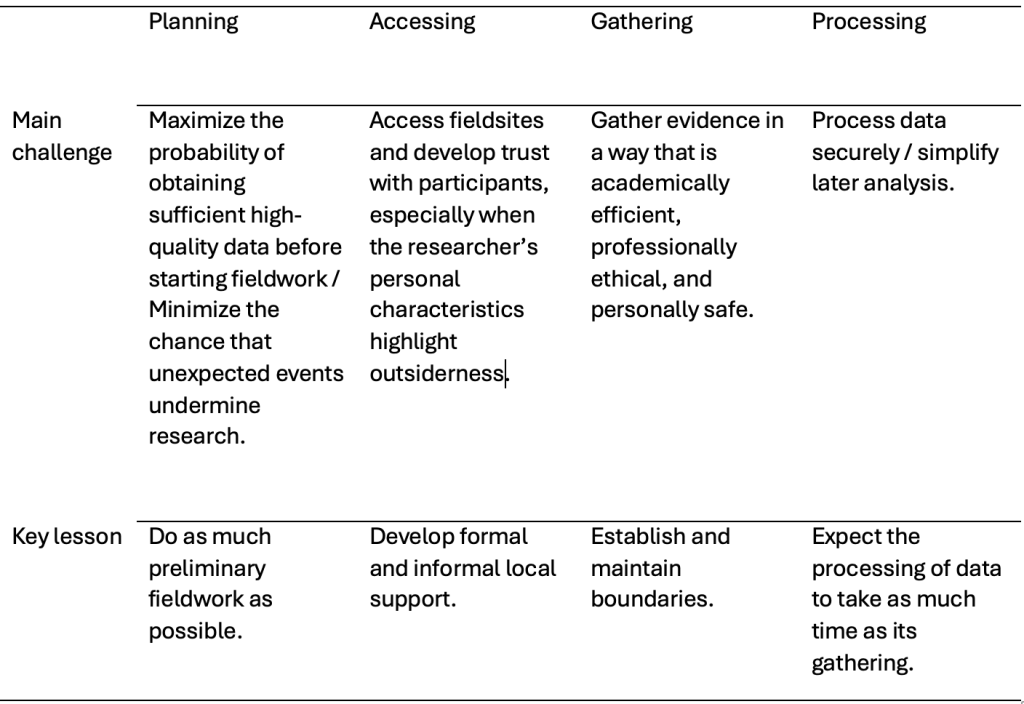
We organize our ideas by dividing the fieldwork experience into four stages: planning, accessing, collecting and processing (see table below). At each point we identify the main challenge, and a key practical lesson. This way, we highlight that projects begin much earlier than research trips and conclude long after the researcher has returned from the field.
Planning
When dealing with planning, the challenge is coming up with a strategy that maximizes the chances of obtaining enough evidence. Early decisions in this regard can have significant consequences down the road. The key lesson is to avoid (whenever feasible) limiting fieldwork to one long period, and instead to do as many preliminary trips as possible. Furthermore, while the value of physical presence is great, the popularization of tools such as encrypted messaging and videoconferences means that some initial work can be done remotely. Early exposure to the field allows researchers to familiarize themselves with the case and sharpen their methodological tools. Perhaps most importantly, data collected early on can serve as insurance against any unexpected events that may jeopardize access to the field later.
An example of this dynamic is Hyun Jeong Ha’s work with Christian communities in Egypt. Ha’s decision to conduct research in Cairo during the summer of 2010 (early in her graduate studies) ended up being providential when a year later the Arab Spring triggered a period of unrest which made further visits impossible until 2014. Her exploratory fieldwork helped her not only refine the project, testing ideas and identifying key gatekeepers, but was also essential to her ability to sustain it until travel could be safely resumed.
Preliminary research also gave Ha important insight about her own positionality in the field. Of particular importance was the identification of potential obstacles and opportunities. As many ethnographers have experienced due to the methodology’s invasive nature and colonial roots, Ha encountered suspicion from potential interlocuters. Some people perceived her either as an intelligence agent sent by the US government or as a Muslim woman collecting information on church activities, despite her openness about being a Protestant Christian. However, Ha also experienced moments of unexpected openness from younger Egyptian women who were passionate about TV shows, films, and music from her native South Korea. One of them was even a Korean language major at her college in Cairo, and she ended up helping Ha with her Arabic in return for Korean language lessons. The hospitality of these younger women helped Ha advance her project despite substantial barriers.
Accessing
At the accessing stage, we identify the main task as developing trust with participants, especially when the personal background of the researcher emphasizes his or her outsider status. The key lesson is the importance of local support, both formally (institutional affiliations) and informally (daily life). Fieldwork can be isolating; thus, investing in the development of relationships with colleagues and acquaintances can make a big difference.
The experience of Caitlyn Collins supports this argument. For her book on working mothers in Europe and the United States, she was unique among us in that she did not concentrate in one main location, but instead did shorter periods of intensive research in different cities. Having affiliations with local institutes, as well as spending free time with residents, was essential in providing insight and logistical support.
Fieldwork can be isolating; thus, investing in the development of relationships with colleagues and acquaintances can make a big difference.
Collin’s coworkers and roommates were invaluable in recruiting interview participants and helped her deepen her knowledge of the local history, politics, and culture. They also served as local sounding boards for developing ideas. Often, she would arrive to the office or return home and chat with others about what she learned from recent interviewees, bouncing thoughts around and asking for more context. Collins also benefitted from spending time informally before and after interviews with participants. Sometimes this meant chatting over a meal at a café or in a home where an interview took place; sitting together at a woman’s kitchen table or in their backyard with their partner, children, and friends; taking a tour of their workplace; going for a walk around their neighborhood; or enjoying the sunshine together on a park bench. Developing deeper personal connections with interviewees led to further support, both personally and professionally.
Gathering
The next step in all projects is actually gathering data, and here the key question is how to balance academic efficiency, professional ethics, and personal safety. We argue for the importance of boundaries as tools to ensure these goals. Researchers should reflect proactively about their priorities, strengths, and limitations, sharing these with relevant people (advisors, colleagues, relatives, participants), and maintaining them throughout the project. Boundaries should not be considered self-imposed restrictions on data collection, but methodologically-oriented decisions that can enhance both a researcher’s wellbeing and his or her perceptivity.
The paper illustrates this point with Vivian Shaw’s work on activist networks in Japan. After overexerting herself for several months, she eventually concluded that enduring long periods of intensive fieldwork would require her to strategize data collection and prioritize her personal safety and mental health. To her surprise, establishing these boundaries allowed her to identify previously hidden dynamics among her respondents, many of whom struggled with issues that were familiar to her.
Boundaries should not be considered self-imposed restrictions on data collection, but methodologically-oriented decisions that can enhance both a researcher’s wellbeing and his or her perceptivity.
In other words, rather than pushing through the field with a “more is better” attitude to data, taking a step back gave Shaw crucial insight into the asymmetries of power that structured the lives of her respondents. As she found herself leaving events around 10 pm, she began noticing that activist women were doing the same. These individuals were not negotiating their boundaries in relation to a research project, but nonetheless experienced a conflict between the demands of activism and their own self-preservation. Their strategies of self-protection also reflected their years of navigating misogyny in all parts of their lives. Shaw eventually learned that sexual harassment was a key concern for women in the movement, which had been marred by several serious incidents. This pattern offered a key finding about gender politics within these communities.
Processing
The final component of fieldwork is turning raw data into analyzable evidence. Fieldnotes have to be written, recordings transcribed, archives organized, and information secured. These tasks are frequently overlooked, but a key lesson is that the processing of data takes as much time as its gathering (if not more). Early-career scholars must plan accordingly, devising tactics and devoting resources to increase the efficiency of this step. Particular attention must be given to new technological tools that can help, including hardware (high-fidelity recorders and transcription pedals) and software (speech recognition and translation assistance).
It is important to highlight that many of the practical challenges and solutions associated with processing qualitative data are common to researchers regardless of which country they study. That being said, international fieldwork adds its own complications. In particular, the higher probability of cultural and linguistic differences increases the need for translation and contextualization, both internally (for the analyst’s own records) and externally (for potential audiences). When the content of interviews has to be translated (at least partially) and field notes end up including a larger portion of clarifications, an additional task is added to an already burdened fieldworker.
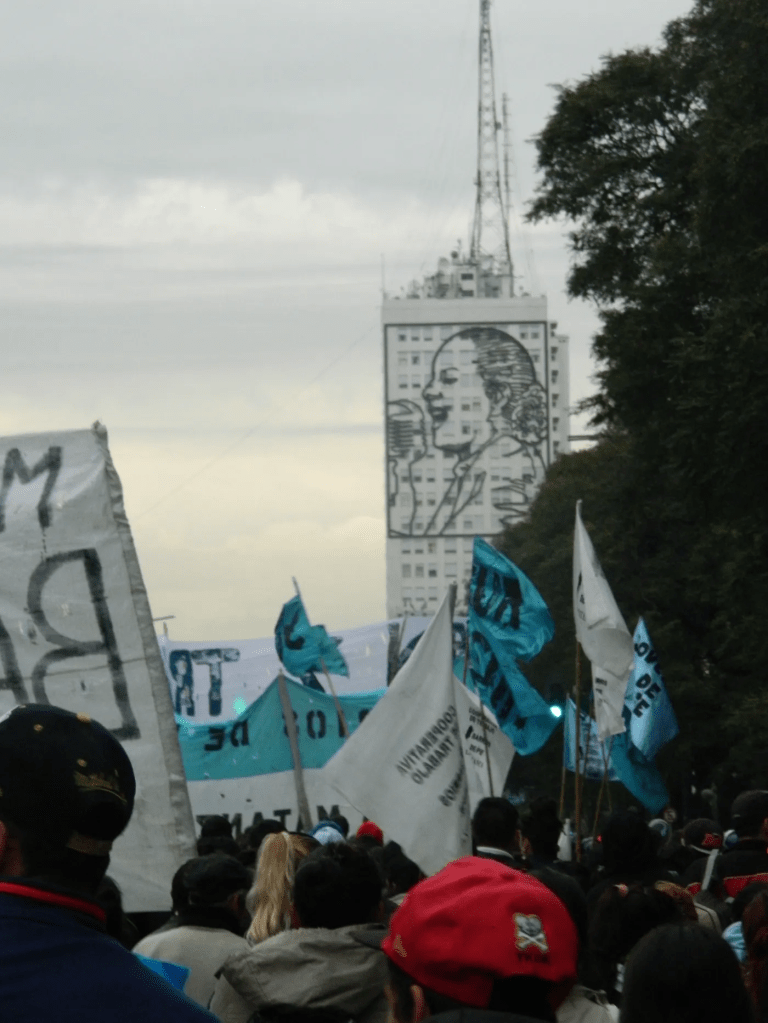
My own research with unemployed activists in Buenos Aires shows the risks of underestimating the demands of processing data. A typical day in the field entailed long commutes, hours of observations and interviews, and attending to countless side tasks. In that context, writing notes (usually late at night) became the most burdensome part of the project. During particularly busy moments I audio recorded my notes, which I wrote down later. This, however, did not solve the problem of transcription. Halfway through the project I obtained a grant that allowed me to hire local assistants, but by that time I had processed 50 interviews, many of which were recorded outdoors and had low quality. This caused the work to extend long after returning to the United States. A pedal bought by my department simplified things, but the task was still arduous. Without transcriptionists for the remaining interviews, I would have had to postpone dissertation writing by months.
Looking Forward
Of course, we do not claim our experiences to be applicable to every graduate student. Each topic, fieldsite, and project is different. The resources available vary significantly not only between departments, but within them as well. Challenges (and the solutions to them) are very diverse. The field is constantly evolving, with new procedures, tools, and technologies. Our goal is to contribute to a growing conversation on these issues, as well as encourage scholars (particularly those at the beginning of their careers) to discuss the practical challenges of our line of work.
Marcos Emilio Pérez is Associate Professor of Sociology at Washington and Lee University. His research focuses on social movements, grassroots politics, and state repression in Latin America. He is the author of Proletarian Lives: Routines, Identity, and Culture in Contentious Politics (Cambridge University Press, 2022) and ¿Que Tienen los Piqueteros en la Cabeza? (Siglo XXI Editores, 2024). His work has appeared in the Latin American Research Review, Mobilization, Qualitative Sociology, Conflicto Social, Sociedad, Argumentos, Latin American Perspectives, the Bulletin of Latin American Research, and the Journal of Contemporary Ethnography, as well as in several edited volumes.
borders fieldwork Methodology mobility reflections research process ethnography anthropology reflexivity

 Ethnographic Marginalia