Challenging borders from a pair of pedals: Ethnographic insights of the bicycle riding migrant diaspora in Chiapas, Mexico
13 January 2025
Rogelio Ramos Torres
On the road
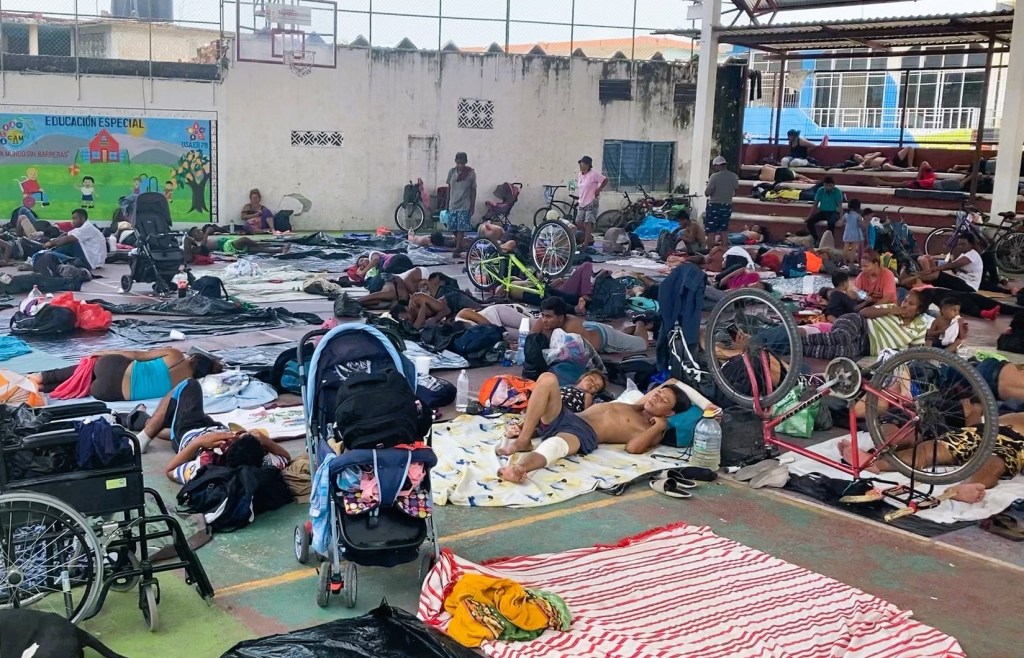
A misty moon shines at midnight over a rushing crowd in a sports park on the coast of Chiapas, Mexico. More than three thousand people, members of one of the last caravans that for some years have been crossing the country heading north, are preparing their departure. The pastors leading the group give instructions, the tents and tarpaulins that have served as shelter are dismantled, the stray dogs sniff for waste, the mothers pack clothes and water bottles, the children wake up, young people put on their shoes, old people stretch their backs to alleviate the pain, the backpacks go to the shoulders, the soles strike the ground and the march begins. It is essential to go ahead of the sun. Some make their last purchases from soda or food vendors who, even at that hour of the night, come to the road. “I don’t know what we would do without these people, if it weren’t for them we wouldn’t be able to make a little bit of extra money, may God be with them,” says a female vendor, referring to the migrants.
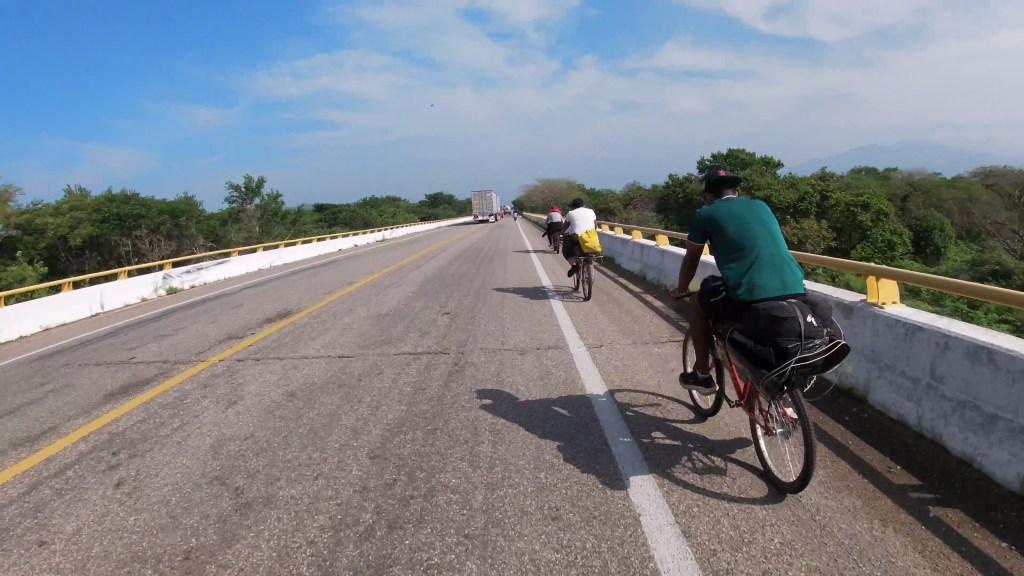
The movement of the crowd raises the dust, the road lies impassive, prowling under the thousands of footsteps that make its asphalt tremble. The trajectory of a bicycle cuts through the crowd like a knife. Behind it appears another one, then another one, then a big contingent that rolls rhythmically immersed in the crowd. By the time the whole caravan is on the road, hundreds of bicycles emerge from the masses, with their horns and their chrome shining in the backlighting of the night, advancing like those solemn flocks that parade the steppes. Pairs and pairs of wheels that turn stealthily, entering the route with their load on their backs, bags, carboys, brothers, wives, grandparents, and children who cling to the pilot while contemplating the walking of the rest of the caravanners.
A particularly tough stretch awaits them; the Isthmus shared by Chiapas and Oaxaca is ecologically hostile. “There are no trees here like in the other parts of the road, brother, and the heat is stronger,” says a young Ecuadorian to his companion. At this point, the caravan has already walked about two hundred and fifty kilometers, and another fifty await them on this new journey. The objective is to reach San Pedro Tapanatepec, where they are going to re-evaluate the options to reach Mexico City first, and then the United States. For the most tired the journey will be hellish. The accumulated distance mercilessly punishes the soles of their feet, and they walk gritting their teeth hard and pretending that the sores do not hurt, as if fever and dehydration were not permanently on the prowl.
But for cyclists it is different. Their presence suggests the migrant phenomenon is reaching another level. Because, as novelist Eraclio Zepeda wrote somewhere, the road sees everything, and those who live on the road know a lot, and can find every footprint, every house, every beast, every death. This is what the migrant march is like, a journey that at every step gathers learning that instinctively adheres to the body. The incorporation of the bicycle is part of this training. Some of those who have the best information about the conditions of passage through the country arrive at the border with Guatemala seeking to acquire one. Nonetheless, several are discouraged by the rumors: “they told us that the National Guard takes everything from you at the Viva México checkpoint, that’s why we didn’t buy a bicycle in Tapachula.”
The truth is that, when the caravan leaves the southern border of the country, there are only a few who pedal. Most of the travelers face the road in harsher, more grueling, more brutal terms. In this sense, the road is a severe teacher, its pedagogy is that of hundreds of traps and pitfalls placed by the institutions of a country that does not quit behaving as its neighbor´s watchdog, but also by criminal organizations that prey on the roads. The incorporation of the bicycle is largely dictated by the need to circumvent these traps, and to make transhumance an antidote, a frontline capable of breaking the obstacles that deny the right to leave behind a past and aspire to a future.
“Well, I have my business here, I am a mechanic and we also patch tires. And we do see migrants pass by every day, and we help them as much as we can. Lately many come by bicycle, sometimes there are only one or two of them. But sometimes as many as thirty or forty pass by, and then from time to time we help them by making minor repairs to their bikes as they rest for a while here under the trees,” says Martín, who works alongside the Panamerican Highway.
Because, as novelist Eraclio Zepeda wrote somewhere, the road sees everything, and those who live on the road know a lot, and can find every footprint, every house, every beast, every death. This is what the migrant march is like, a journey that at every step gathers learning that instinctively adheres to the body. The incorporation of the bicycle is part of this training.
Pedaling among borders
For the migrant diaspora, to cross the Suchiate river and go on foot means to walk carrying on their shoulders the tyrannical burdens of moving borders, borders that chase those who dare to challenge the mythologies of the Nation-State, for whom the purity of sovereignty implies looking at others as contaminating agents. We live in days in which you can be human as long as you are first a citizen. For this reason, the Iranian anthropologist Shahram Khosravi (2010) argues that borders are not only the lines between countries, but the devices that delineate our way of seeing the world. Hence, the greatest challenge for the migrant is to shake off the border, and they have found in the bicycle a helpful tool for this objective.
In this context, the bicycle is proof that the lesson contained in the small print of territorial clauses has been learned. If the effectiveness of a border is measured by its capacity to stop people, migration is measured in terms of movement, in non-stopping revolutions. An essence that finds in the bicycle a good way to sustain itself when all other ways have been closed. Because, since the authorities prohibited the sale of bus tickets to migrants in the south of Chiapas, the State bet was clear: to brand them with the mark of illegality and abandon them to their fate.
That is what borders are for, states philosopher Giorgio Agamben (1998), not for the State to exercise the violence whose power it has among its faculties, but for leaving people on their own waiting for others to be the perpetrators. Therefore, migrants are forced to suffer the risks of the roads and highways, expecting that their cannibalistic appetite will devour them sooner or later. What the authorities never expect is their audacity, which in this new episode has found in two wheels the resource to jump for the umpteenth time the roadblocks and defy, once again, with movement, all prohibitions.
The bicycle as a self-defense strategy
To follow the route within the caravan is to immerse yourself in a march as obstinate as it is cruel, painful and pungent, but optimistic and hopeful at the same time. The movement of the strongest ones is full proof, they can walk and walk without hesitation. For the most vulnerable, on the other hand, the sacrifice is enormous, the heaviness of their advance gradually leaves them behind until the great human snake is fragmented into small groups that become separated dozens of kilometers from the leaders.
The last ones will arrive covered by dust, exhausted, dehydrated, sore, reduced to human detritus. Their delay will mean resting much less, accepting the left over and least comfortable places in the camping sites. Nor will there be much strength left to go in search of food or remedies for their ailments, thus inaugurating a vicious circle in which the walk will progressively eat away at their bodies. They cannot, however, allow themselves to stay behind; to be left out of the caravan is to fall into the hands of the agents of the National Migration Institute, the National Guard, or the coyotes and criminals who thrive along the routes. “I fell in the ditch on the highway,” sobs Elvira, a Salvadoran woman, from the bench where she was prostrated with a splinted foot. ”It was already night, I couldn’t see well and since I was going all the way to the back they made me run, and my foot went to the side. A patrol car brought me here to the hospital, then they treated me and took me out here to the park. Now I don’t know if I’m going to be able to catch up with the caravan.”
Her case contrasts diametrically with that of Amrrita, also a caravanner, Guatemalan, twenty-two years old, traveling with her boyfriend and his father. She is seen momentarily leaving the lines and pedaling to a coconut palapa on the other side of the road. It is less than ten kilometers to Tapana. She looks strong, fresh, in a good mood. “We bought the bike in Huixtla, it cost us a thousand pesos, we just put some rear mounts on it to hop on it. Well, then one of the pedals fell off, but we fixed it. My boyfriend is the one who rides, sometimes he takes me, sometimes his dad. We didn’t have enough money to buy another bike, but we are doing well anyway. If everyone in this caravan brought a bicycle, just imagine, we would have arrived in Mexico City by now. Because right now, look, how many are still to arrive.”
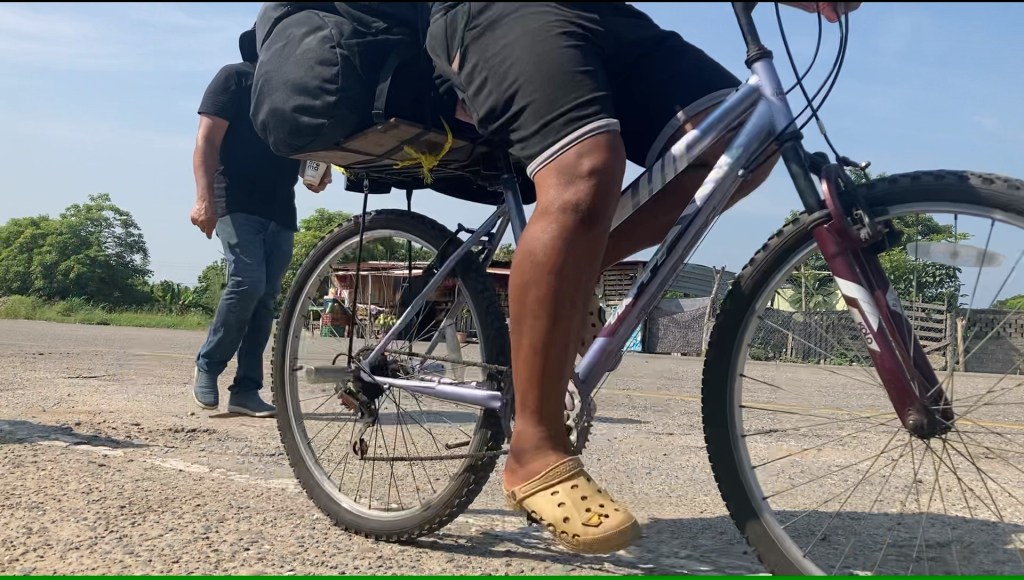
For academics Amarela Varela and Lisa McLean (2019) caravans are self-defense exercises; they recall how in the first versions migrant people could be seen using strollers, backpacks and other objects as armor to cross the infamous migration fences. The bicycle is a new ingredient in that same strategy, since, by allowing people to stay within the contingent, it helps to avoid losing the protection of the group. The bicycle adds, in this way, capabilities to self-protection and contributes to avoid the depletion of the forces that make up the group. Pedaling together with the rest, in this sense, is a support, a movement that, as in the case of great cycling races, finds in the peloton the necessary dynamism not to be left behind. A quality that, within the migrant experience, provides a valuable autonomy that, among other things, also helps them avoid disaster.
A moving capital
Owing to these kinds of benefits, the bicycle also becomes a coveted capital on the road. The caravan, after all, is a wandering market in which the ability to move determines the price of things. Just like what happens in some rough neighborhoods of the United States, where, as journalist Parick Symmes (2021) reminds us, sex, drugs, cash and bicycles are common currency. In this way, the vehicle becomes an itinerant asset that people dispose of when the need arises.
Pedaling together with the rest, in this sense, is a support, a movement that, as in the case of great cycling races, finds in the peloton the necessary dynamism not to be left behind.
This is what Sergio and his wife, Yessica, both Guatemalan, did when they bought a bicycle to transport their two small children and had to sell it a few kilometers later when one of them fell ill and the price of the consultation and medicines forced them to get rid of it. This opens possibilities for opportunists to profit from the need. “I was able to buy medicine and my son is doing better, look at him. After that we only had enough for this little bike, it has no chain and it has flat tires but it helps me to carry my children. They sold it to me for three hundred pesos,” Don Sergio relates.
And yet, the caravan is also a hodgepodge of human ties in which reciprocity plays a determining role, and the bicycle can be a useful glue to reinforce this amalgam. According to Marc Augé (2008), sometimes it is enough to leave bicycles at people’s disposal for sociability to work by itself. “I had an accident back in Ecuador”, says a young man in his thirties who drags a leg with the tibia and fibula pierced by a huge scar. “I can hardly walk, yesterday I was in a lot of pain, but here some colleagues lent me a bike. If it hadn’t been for them I might not have made it. That’s why I told them that now I’m going to pay for a hotel room for all of us.” The caravan, from this point of view, is a space of care and solidarity, “there are good people in this caravan, there are many who help, who give their food, who lend their things,” confirms Yessica.
Unfortunately, the number of bicycles is not enough to help all those who need it, and thousands are forced to walk for hours in apocalyptic conditions, marching in long lines of agony, in bloodsoaked shoes, with their faces burned by the sun’s rays, among women fighting against fainting, aside children clinging to their parents’ necks, in the middle of hundreds of thirst-broken lips and throats as dry as the road itself. These are the conditions in which caravans arrive at the border with Oaxaca, amidst short trees that haggle over the shadows and lying iguanas that rest on a boiling asphalt road. The Isthmus weighs its empire and the battered bodies accuse it. Leaving Chiapas behind takes enormous sacrifice. By now several are sick, some have been left scattered on the road and one person is dead under the tires of a truck.
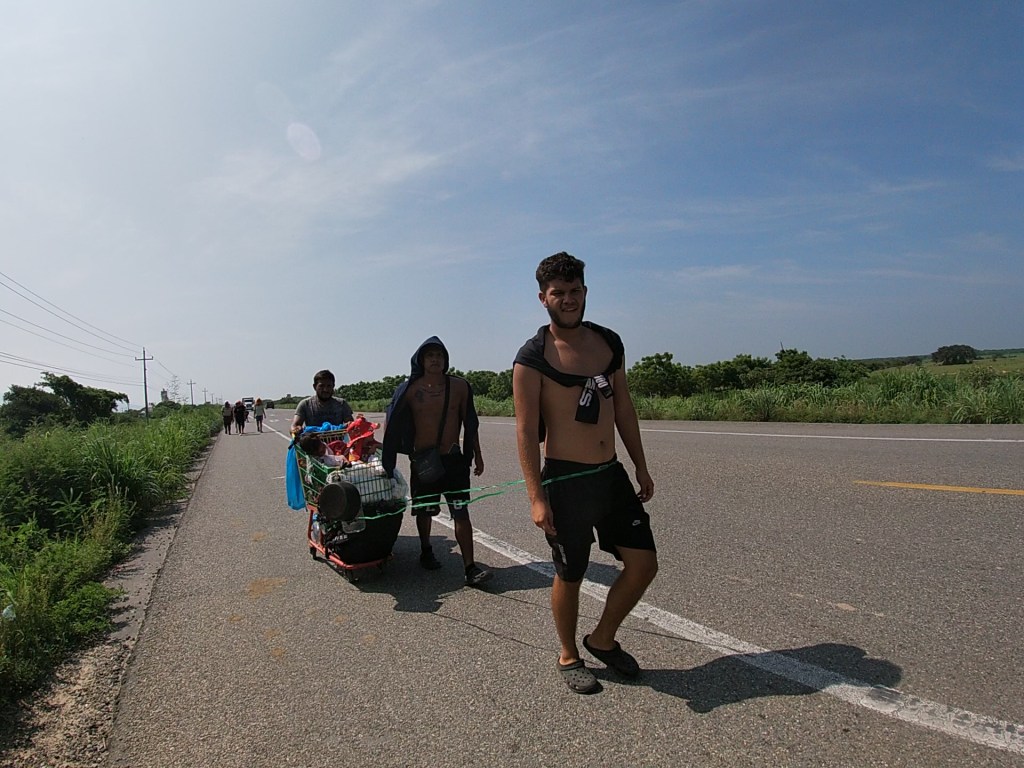
“The pastor believes that we can all walk like him, but here, among us, we have diabetics, elderly people, children. Look at my feet, it’s no excuse, I can’t walk anymore, it’s not that I don’t want to, it’s that I can’t,” says Patricia, a fifty-two year old Guatemalan woman who, sitting on a sidewalk, rubs her swollen calves.
Bicycles for fun
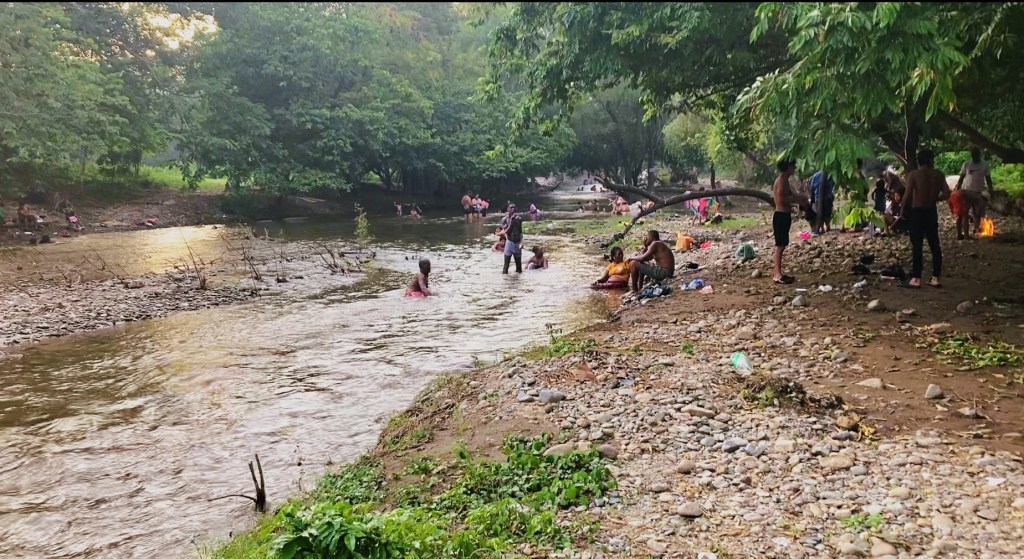
In Tapanatepec, health services are ridiculously deficient, and for many who cannot afford a doctor, only the Novillero River remains as a last gentle resource to alleviate the heat and pain. Its waters fall like a balm on the boiling skin. Hundreds of wet bodies sheltered by the great shadows of the savin trees splash around, temporarily populating the riverbed. It is five o’clock in the afternoon. Seventeen hours of walking, and there are still people from the caravan who have not yet arrived. The public spaces of the village are already crowded. Dozens of people on foot and on bicycles travel up and down the streets carrying bags of rice, beans and salt to the camps. On the banks of the river, small fires are already being lit to serve as stoves. A group of young, corpulent Cubans arrive, also pedaling, to these banks to take a bath.
Roberto, a Honduran, places his 24-wheeled velocipede under the tarp that serves as a roof, “I bought it – the bicycle – for my wife in Tonalá. It has helped a lot for her blisters. I used to see other people riding around on their bicycles as if nothing happened, they were even having fun. Just look what those little kids are doing now.” And it is true, there they are, in complete joy, playing on bicycles that others lend them and that sometimes they do not even manage to pedal, as if they had not just traveled a deadly route, as if the next day that same route would not be waiting for them to put a new parenthesis to their joy. Perhaps, for that very reason, the game is so precious and is enjoyed so intensely during moments of leisure, because it is an ephemeral evasion against the fickleness of a horizon that the next morning will endorse its harshness. But in the meantime, life also opens spaces for fun and laughter, because sometimes, says the writer Eloy Tizón (2017), bicycles are musical instruments that are also useful to move.
Migrants and bicycles
Despite the violence in which it takes place, the encounter between bicycles and migrants is in a certain way poetic. Two figures that, in today’s world and in places like Latin America, are subjected to profound spatial injustices and yet have a powerful capacity to overcome barriers. For researcher Eduardo Torre (2022), the migrant caravans are social movements that wage a struggle of protest and denunciation against the prevailing border regime in the region, a combative mood shared by the cycling movements of many cities as well, which fight for the recognition of their right to mobility in conditions in which privileges are all on the side of the motorists. Migrants and bicycles are two representatives of liminal forms of movement, outlawed by the neoliberal logics that stipulate that the freedom of movement of some is paid for by the immobilization of millions.
Migrants and bicycles are two representatives of liminal forms of movement, outlawed by the neoliberal logics that stipulate that the freedom of movement of some is paid for by the immobilization of millions.
And yet, there they are, defiant, emerging from a throbbing South at the forefront of trajectories that swing between place and non-place, creating a locomotive hybrid impossible in other contexts. The bicycle provides migrants with the power to free themselves from the immobility imposed by the border, just as the migrants return to the bicycle a political dimension as an expression of popular sectors, of cultures and ways of life that long found in this vehicle the possibility of prevailing. For Italian historian Steffano Pivato (2019) the history of an era can be told through its bicycles, and perhaps the synthesis of migrants and cyclists that has proliferated for at least two years on Mexico’s southern border is nothing more than a temporary, passing phenomenon. But it also remains as one more testimony of the human capacity to break the moorings when borders are imposed as the main way to order the world.
References
Agamben, Giorgio, 1998. Homo Sacer. El poder soberano y la nuda vida. Pre-Textos, Valencia.
Augé, Marc, 2008. El Elogio de la Bicicleta, Gedisa, Barcelona.
Khosravi, Shahram, 2010. “Illegal” Traveler. An Auto-Ethnography of Borders, Palgrave McMillan, United Kingdom.
Torre Cantalapieda, Eduardo, 2022. “El Estudio de las Caravanas Migrantes en México”, en Norteamérica, Año 17, número 2, julio-diciembre, p.p. 67-89.
Varela Huerta, Amarela y Lisa McLean, 2019. “Caravanas migrantes en México: nueva forma de autodefensa y transmigración”, en Revista CIBOD d´Afers Internacionals, nº 122 (septiembre de 2019), p.p. 163-185.
Pivato, Steffano, 2019. Storia Sociale della Bicicletta, Il Mulino, Bologna.
Tizón, Eloy, 2013. “Pide tres deseos”, en Diez Bicicletas para Treinta Sonámbulos, Titibilus, España.
Symmes, Patrick, 2021. “Who pinched my ride?”, en Outside, Junio 26, 2021.
Dr Rogelio Ramos Torres has a PhD in Social Anthropology from the Mexican Center for Research and Advanced Studies in Social Anthropology (CIESAS), where he is a post-doctoral fellow. He has accompanied and documented programs of social prevention of violence, social movements for human rights, as well as social recovery processes in disaster contexts. His work is currently developed in coastal environments, where, through qualitative techniques and from the perspective of political ecology, he investigates issues related to the political construction of socio-environmental risks, processes of violence and social movements in defense of territories. He is also a full-time cyclist and occasionally writes about the social dimensions of cycling in urban and rural contexts.
He can be found on X (formerly called Twitter) at @rojosratos
borders Methodology mobility Reflections anthropology ethnography reflexivity

 Ethnographic Marginalia